Saturday, May 29, 2010

Exit through the Banksy Effect

People are often surprised to discover that I despise Shepard Fairey but adore Banksy (one of his images, at left). But . . . aren't they both graffiti artists? these types usually sputter. Yes, but one's talented, the other isn't. And that makes all the difference. At least to me.

Other people feel differently. Indeed, what's most frustrating about the Fairey cabal is how they imagine the case against street art (and it's a genuine case) somehow transforms their vacuous "rebel" into a real artist. Only sorry - spray painting other people's imagery on still other people's property does nothing of the sort; it can only buy you cachet in the cool, foolish crowd that follows art but doesn't understand it.

Meanwhile it's true that you can legitimately oppose Banksy for vandalism and trespass - but at the same time, you have to admit the work itself is bitterly, humanely brilliant, and instantly memorable, and has been for nearly a decade. In fact Banksy seems to be the only street artist who reliably comprehends the nature of street art. Shepard Fairey just plasters his dopey "Obey" logo all over everything - but Banksy's work is usually politically up-to-the-minute, and also quite site-specific; it looks like it belongs where he has put it. If he "vandalizes" the street, then he activates it, too: it's no surprise that his graffiti, so clever and so tailored to its site, often becomes a local touchstone. And he's just so damned funny - his sense of satire qualifies him as a kind of Daumier of the street, in fact, and he's so far ahead of the pack intellectually that sometimes it seems the pretensions of the whole movement are riding on his coattails (a phenomenon which already has its own name, "the Banksy effect").


Welcome to the rat race: early Banksy.

The artist himself seems aware of this irony, and his new movie, Exit Through the Gift Shop (now at the Kendall Square Cinema), operates as an acidly hilarious satire of his own milieu - or rather the arty milieu that has lined up to exploit his milieu. Got that straight? I know it's hard to, particularly when you're watching Exit, which is, amusingly enough, a documentary not about Banksy but about the celebrity of someone who for years hounded the artist because of his celebrity. (Even though Banksy insists on a strict code of anonymity from all his associates.)

Yes, the movie's central concern is (wait for it) the paradox of anonymous celebrity. The fame of the unknown. Lady Gaga gone underground - that's Banksy. And that contradiction - and its ramifications - may be what makes his movie one of the funniest of the year.

Which isn't to say that the artist isn't (almost) as rich as Lady Gaga. He is; Banksies have sold at auction for hundreds of thousands of dollars. It's hard to begrudge him the cash, however, when his workshop keeps churning out such high-quality, politically edgy stuff - and when the mechanics of maintaining its secrecy, as the projects grow ever higher in profile (see below), have by now reached astronomical levels of complication.

So it's no surprise the issue of his anonymity/celebrity has figured more and more prominently in Banksy's work. He has already issued parodies of Paris Hilton's notorious recording efforts with titles like "Why am I Famous?" and "What Am I For?" and even ridiculed the collectors who have paid so much for his own pieces. At a deeper level, these japes hint at a more serious question that has emerged about his career: can you be a celebrity and still be genuinely political, authentically "street"? In fact, Banksy's greatest challenge may be shielding his work from his own increasing success - and the resulting efforts to "out" him. For how could he carry off his ongoing critique of power if his identity became known? His secrecy is his identity. If we find out who he is, his career (at least as we know it) will be over. And the rearview mirror is full of pop artists like Warhol and Basquiat whose edge was compromised, or ruined, by their celebrity. To his immense credit, Banksy doesn't want to follow in their footsteps.


Much better than "Obey:" Banksy on the West Bank.

Although plenty of other people would like to follow in his. Which leads us to Exit Through the Gift Shop, and its putative subject, Thierry Guetta (a.k.a. "Mister Brainwash"), a would-be documentarian who seems to have spent years tracking the likes of Shepard Fairey and the even-lesser street talent "Invader." Guetta seems like a sweet, shaggy obsessive-compulsive in the thrall of street art, to the point of following artists onto precarious ledges and rooftops (I'll say this much for Shepard Fairey, he's got guts). His finest moment probably comes when he's nabbed by security while documenting a particularly daring "installation" by Banksy in Disneyland. Guetta may come off as a scruffy stoner, but he doesn't crack under pressure; and his video of the park's reaction feels quite a bit more subversive than the artwork itself.

But like many an obsessive-compulsive, Guetta doesn't have what it takes to pull together his hours (and hours) of footage into a completed work; when he tries, the results scan like a bad acid trip. So Banksy "suggests" that Guetta try his hand at actual street art instead - while Banksy plays documentarian.

What happens next may well prove a source of debate for years to come. To hear Guetta tell it, he quickly put together a giant show of art, staged in an abandoned L.A. studio building, and modeled loosely on Banksy's own "elephant in the room" show a few years before (below). Banksy gave the event his imprimatur, and their now-joint "documentary' morphed into an account of Guetta's struggles to mount an extravaganza that would prove hipper and more ambitious than his mentor's. 

Given Guetta's seeming jittery incompetence, the actual work of the installation fell to an army of assistants - who worked frenetically, and without direction, round the clock - even as L.A. hipsters lined up outside the building for a chance to ogle the goods. The surprise is that - as even the installers dazedly admitted - while the logistics of the show were a nightmare, the pieces themselves were actually professionally produced, and kind of fun; a Warhol soup can re-configured as a spray can was one typically witty gambit. The show became a sensation - it ran for weeks - and Guetta sold something like a million dollars' worth of art. Now established, he began planning a similar show for New York, and soon was signed by Madonna to do her "Celebration" album cover.


The famous "elephant in the room" from Banksy's "Barely Legal" exhibit in 2006.

But did Guetta himself really produce his own images and objets? It does strike one that much of the stuff seen in Exit was probably by Banksy's studio (although it had been drained of any sense of protest). The Michael-as-Marilyn paintings look a lot like Banksy's Kate-Moss-as-Marilyn parodies, for instance. And none of Guetta's "Mr. Brainwash" work has actually passed through the hands of a gallery (he organizes his shows himself), so his whole operation has never been vetted by outside eyes. Indeed, it's quite possible that some, and maybe all, the collectors snatching these items up were doing so on the hunch that they could actually turn out to be cast-off Banksies.

Which leads one into a fascinating hall-of-mirrors-style artistic debate. Who is zooming whom, to be honest, in the tale of Banksy and the aptly-named "Mr. Brainwash"? Or is anyone zooming anyone? Yes, I know, Ty Burr insists that Thierry Guetta is for real, because "this story’s too good, too weirdly rich, to be made up." Uh-huh. Add that to your next letter to Santa, Ty. The only real question is whether Madonna and the hipsters "know" at some level what they're participating in. It's obvious that Banksy takes Mr. Brainwash as an Art-Basel-style inflation/desecration of street art. That, of course, doesn't mean he didn't set the whole thing up. But has anyone really been duped (aside from Ty) by his machinations? Or is the Mr. Brainwash phenomenon a tongue-in-cheek mode of self-critique by the hipster herd, an art-zombie march to Banksy's tune-at-one-remove?

Of course Mr. Guetta may have been a kind of dupe, as he innocently ripped off his idol without ever guessing at Banksy's deeper intentions. Then again, maybe Guetta was in on the scam, and appreciated it as a kind of giant conceptual graffito sprayed across the art world. Perhaps some members of the movie's audience have been fooled - but then again, Exit wouldn't be much of a movie if Guetta's show had failed, would it. The point is, I think, that it doesn't really matter either way. However you slice it, Banksy has made his horrified statement about his own success via this factotum - and Exit Through the Gift Shop probably stands as the largest work of conceptual art ever realized. Which does give me some pause; I mean, I know Banksy is brilliant - but is he that brilliant? Dr.-No brilliant, hollowed-out-volcano brilliant? Indeed, the movie seems to me to hint at some frightening new arena of artistic endeavor - the "flash mob" gone meta, in which actual human society becomes an arena for staged, "faux-real" events. 

On the upside, however, there is the following to ponder: Does this mean Banksy could be clever enough to engineer sending Shepard Fairey to prison? 

And keeping him there?

Thursday, May 27, 2010

Call Scott Brown today

Today, the Senate Armed Services Committee voted to end the military's discriminatory "Don't Ask, Don't Tell" policy. This vote was the first step toward overturning the 1993 law, which has resulted in the discharge of more than 13,500 service members. The repeal has been attached to the Military Reauthorization Bill, which must be approved by the full Senate.

Massachusetts Senator Scott Brown voted against the repeal in Committee and has said he will vote against it again in the Senate - even though 77% of his constituents disagree with him. You can tell Senator Brown that bigotry has no place in the US military by calling his Boston office at (617) 565-3170 or his DC office at (202) 224-4543. Ask that he reverse his vote when the Military Reauthorization Bill reaches the floor of the Senate. America's gay servicemen, who deserve your support and respect, will thank you. As will I.

Tuesday, May 25, 2010

Something about Mary


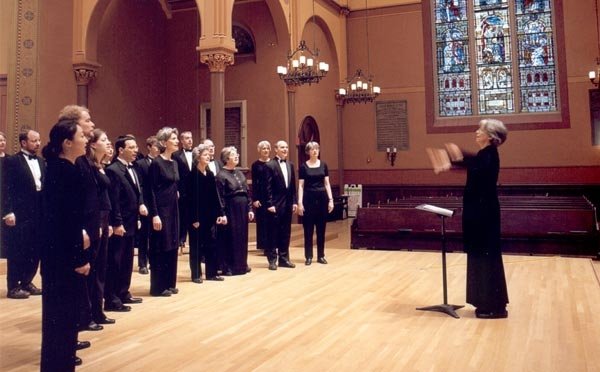
Mary Beekman leads Musica Sacra.

This season Musica Sacra is celebrating both the 50th anniversary of its founding and the 30th year of conductor Mary Beekman's artistic leadership - and the icing on the cake of this year-long party was last weekend's "Mary's Playlist" concert, a compendium of Beekman's favorites from her three decades of conducting the group.

Few local arts organizations have had that kind of long-term relationship with a leader; by now, in fact, it's hard to imagine Musica Sacra without Mary Beekman, who was her usual gently authoritative and precise self onstage last Saturday. Her playlist wasn't really much of a surprise, either - fairly eclectic, yes, but generally moving and humane, flecked here and there with touches of open-minded whimsy and experiment.

The group itself sounded much as it did when I heard them a year or so ago - Musica Sacra still is strongest in its sopranos, but Beekman nevertheless sculpts a rich and balanced sound, with a remarkably sensitive dynamic, from her assembled forces. And the chorus seems to know she's drawing out their best; particularly at the concert's close the mutual admiration of this little society was quite palpable, as alumni crowded the stage to sing along with the group's signature encore, the immortal "Teddy Bears' Picnic."

Not everything on Mary's playlist was quite so heavy and dark - there were lighter selections to be savored, such as "Hello, My Baby" (yes, Michigan J. Frog's favorite aria) and "I Wanna Be Loved by You" (Betty Boop's signature tune). I think it's clear from these selections that Ms. Beekman has superb taste, but it's also an eclectic taste in formal terms, and so the concert ran the gamut from Elgar to Mäntyjärvi. I most enjoyed the mournfully beautiful "My Love Dwelt in a Northern Land" from Elgar, as well as James Erb's "My Lagan Love" and especially the haunting Civil War song "Tenting on the Old Camp Ground," which Union and Confederate soldiers may well have heard each other singing across the fields they were battling for. Meanwhile such onomatopoeic experiments as Norman Dinerstein's "Frogs" struck me as good ideas that sometimes outstayed their welcomes; but "Three Choruses from ee cummings" by Peter Schickele (yes, that Peter Schickele) was a delight both melodically and formally. And Mäntyjärvi's "Double, Double, Toil and Trouble" and especially Jim Papoulis's "Kolenna Sawa" ("All of Us Together") were pleasingly adventurous. Actually, some of the chorus needed to attack the stomps and body claps of "Kolenna Sawa" with more passion. But somehow you got the impression Mary would soon see to that.

Master Harold . . . and the girls


Pinter with TV personality Joan Bakewell in the late 60's; their affair inspired Betrayal.

A few months back I wondered whether Pinter was still "possible" - whether in an age that had absorbed his techniques into an ironic culture of sketch comedy, there was still a way to access the atmosphere of threat his work was once known for.

Well, I'm still wondering that after taking in Another Country's production of Betrayal (at the Boston Center for the Arts through June 5), which does boast a clever concept for its set, but conveys little sense of the play's mood or themes. It's too bad, because the actors all have talent, and perhaps with stronger direction the piece might have cohered into an elegant, if arch, retelling of Pinter's famous account of his own checkered romantic history.

Of course Betrayal is far from the rawest Pinter; instead, it's a late, somewhat lesser play - perhaps the last and least of the major plays, autumnal in mood and less brutal than most (at least superficially). The piece casts a coldly melancholic eye back on the author's betrayal of wife Vivien Merchant with TV personality Joan Bakewell (above, interviewing her lover), with whom he carried on a clandestine affair for several years - so clandestine that many early viewers of Betrayal imagined it was about his later affair with Lady Antonia Fraser, whom Pinter eventually married after divorcing Merchant. Bakewell cleared that up some years ago, although even she wasn't aware that Pinter had fathered a child with another woman while carrying on with her.

So Master Harold was a busy boy in his heyday, and it's obvious now that in his "memory plays" of the 70's he did, indeed, have quite a complex personal topography to mine. Betrayal may be the most accessible of these works, even though, as everyone knows, its narrative moves backward in time - well, it actually hops backward, then goes forward a little bit, then hops backward again, the better to limn the tiny betrayals nested like Russian dolls within the larger arc of its characters' adultery.

And the most striking thing about the current production is designer Dahlia L'Habieli's unit-set solution to the staging problems this structure creates. L'Habieli's conceit is to situate the reverse-engineered story in a kind of conceptual art gallery (appropriate enough to Pinter's literary set) in which hang paintings from the various years of the play's action; in between scenes, gallery personnel enter to shine lights on the various dates attached to the paintings to convey that we're taking another backward quantum leap. Clever, no? I thought so.

If only the acting were at the same level as the design concept, all would be well. But alas, the cast has developed its performances via the "Meisner technique" (it's even announced in the program) which a Pinter play requires about as much as a fish needs a bicycle. The Meisner technique (for those unaware) is the source of the catch-phrase "in the moment," and emphasizes spontaneity and a highly attentive, almost improvisatory, performance style between actors rather than the development of interior landscapes; it's great for work without a complex subtext. But of course Pinter depends on subtext, on actors negotiating not only each other but their own subterfuges, wounds, and hidden agendas; it's inward as well as outward. Indeed, Betrayal is basically structured as a slow reveal of a complicated inner history; if that history isn't worked out, the play doesn't really happen.

And here it doesn't really happen; indeed, even its poignant bottom-line arc, from weary disillusionment to headily naïve passion, is only fitfully in view. As Pinter-factotum Jerry, actor Robert Kropf most often seems aware of what he should be doing long-term, as it were; but even he changes far too little over the course of the play, and too often gropes for "fresh" moments, opting for spontaneity over stealth. As the object of his adulterous affection, Lyralen Kaye (at left, with Kropf) sports an intriguingly camouflaged presence that might be right for Pinter - but she keeps things so low-key that we never feel there's really any blood on the floor. Likewise Wayne Fritsche is far too meek and arch as cuckolded husband Robert; there's a cruel, even nasty streak in this character that Fritsche seems unable to convey. He's better at playing regrets - the one scene that mostly clicks is his sad discovery of his wife's infidelity in the script's famous "Torcello" interlude. Meanwhile director Gail Phaneuf pours on the dolor with an inappropriate emo soundtrack. But Betrayal might be better played more in anger than in sorrow.

Monday, May 24, 2010

All in the family

After five years of a bristling existence on Boston's fringe, Whistler in the Dark remains the most daring theatre company in town. In fact, there's no one else even in their league (Harvard and B.U. lag far behind in terms of intellectual challenge, albeit in different directions). Their last show was Naomi Wallace's almost-over-literate diary of a plague year, One Flea Spare. Next season, they're taking on Howard Barker's The Europeans. (Which will make three Barker plays this determined troupe has produced in its short life.) Their idea of a crowd-pleaser is Ovid's Metamorphoses. I repeat: nobody else in town has that kind of balls.

And no doubt our city-wide lack of cojones is behind the fact that the current Whistler project, Family Stories - a surreal, blacker-than-black comedy by Biljana Srbljanovic - counts as the play's local premiere, despite its being penned in 1997. That's right, 13 years ago. Yes, think of that - thirteen years of new play development have filled our local stages with warmth and heart and quirk - not to mention several tons of "uplift." But I can't think of anything that's "developed" that's half as savage as what Srbljanovic calmly serves up here. [Correction! (I've been highly correctable of late, it seems!) I've been informed Family Stories was produced once prior in Boston, eight years ago, by the Market Theatre. Whistler in the Dark still has balls, though.]

The Serbian playwright's conceit is that we're watching children of a warzone play out their "family stories" - violent, brutal fantasies and games that both reflect and refract the destructive adult behaviors they observe around them. The twist is that the children are played by adult actors - yes, adults playing children playing adults - which doesn't so much distance us from their playground horrors as pull them that much closer, while illuminating the childish impulses behind the savagery that inspired them. Not that everything is fun and games - one little girl seems so damaged that she actually believes she's a dog (and is treated as such); her debasement is "real." And the fact that every new day calls for some new sadistic pastime (the parent figures get repeatedly offed in highly creative ways) conjures a powerful sense of the way civil war turns everything - morals, meaning, even time itself - into a repetitive form of chaos.

That said, it must be admitted that the Whistlers don't quite get the tone of the play right: two of the actors - company stalwart Jen O'Connor and newcomer Danny Bryck - capture well the childish affect of their characters. But there's a slightly more ironic, self-aware edge to the work of Melissa Barker and (especially) Nate Gundy that occasionally comes off as arch, and subtly undermines the script with a sense of knowing snark. And director Meg Taintor hasn't found a way to convey the satire of political figures we get the impression the kids are sometimes aping (no doubt Srbljanovic's original Serbian audience picked up on these cues immediately - we don't) . I also felt a real through-line only from O'Connor over the course of the play, which gave the impression that its savagery doesn't progress; which perhaps it doesn't - but it does accrue, and these kids should develop a meta-awareness of their ongoing relationships (and frustrations) with each other outside the confines of their "play."

All that said, much of the action remained almost mysteriously absorbing, and the constant violence, well-designed by Meron Langsner and Mark Villanueva, was always gripping. The set was perhaps too bare-bones - a greater sense of a blasted urban heath was called for, I felt - but in a way this made the text even more strangely free-floating in its ramifications; it was a while, in fact, before I was quite sure what the actors were intended to represent. So let's just say that if you're the type that likes reaching your own conclusions about a play, and you're up for violent confrontation - at least of the theatrical sort - then Whistler in the Dark is for you. Through May 30.

Sunday, May 23, 2010

Run the Marathon!

The Boston Theatre Marathon, that is. Today from 12-10 PM at the Boston Center for the Arts. Fifty plays in ten hours; the line-up is here. At least run part of it! I'll be there roughly from Hopkinton to Natick.

Friday, May 21, 2010

Prelude to a quip

Perhaps time hasn't been kind to Prelude to a Kiss. Or perhaps director Peter DuBois hasn't. Either way, the Huntington stumbles slightly with its revival of Craig Lucas's AIDS-era parable (which runs through June 13). Under the sitcommy direction of DuBois, what seemed poignant in 1988 seems - well, slightly forced, and just plain odd, in 2010.

Back then, the central piece of fabulism in the play - the magical kiss by which the souls of a dying old man and a young bride trade places (at left) - seemed like a touchingly off-kilter metaphor for the transformation that so many young gay men were going through: they were suddenly withering into shadows of their former selves, turning partners and lovers into caregivers desperate to connect to the young souls trapped in those dying bodies. But even then, it was worth noting that Prelude to a Kiss didn't waste too much breath on that sad situation; Lucas included a scene or two in which unhappy husband Peter poignantly tended to the elderly (male) body of bride Rita, but for the most part, the play was concerned with his desperate attempts to magically remedy the situation. Indeed, the script has its most kick not in its Freaky-Friday-meets-Longtime-Companion moments, but rather when it plays like a long-form Twilight Zone episode, complete with cries like "Wait a minute - YOU"RE NOT RITA!!!"

At any rate, if Lucas's conceit is to work, it can only work through actors who convey an unexpected soufulness - or a least a soulmate-ness - through their quirky, cable-TV-level banter. But at the Huntington, director DuBois has cast a nice but average Joe and Jane (Brian Sgambati and Cassie Beck) as his star-crossed, or rather kiss-crossed, couple, and we struggle to see what's so special about their not-particularly-electric chemistry, or, to be blunt, what's so individual about Beck's Rita at all. Beck is clearly a snappy comedienne, and she has a friendly presence - but when she's actually somebody else, she doesn't seem all that different; if her body's new occupant didn't slip up so often on her life trivia, you kind of think he might have gotten away with the whole scam. As for the romantic charge that should by all rights have gone missing from Rita & Pita's love - well, to be honest, it never really surfaced to begin with, even though its existence must be what sparked their whirlwind courtship.

This turns Prelude to a Kiss into kind of a head-scratcher - and its revival is likewise a bit of a puzzle; was anyone crying out for new productions of Craig Lucas? We just got Reckless from SpeakEasy last winter - but taken together, these stagings suggest to me that it's no surprise the playwright's reputation has faded as the AIDS crisis (which served as text or subtext to his biggest hits) has receded in the public mind. Yes, of course, AIDS is still with us - in fact, its incidence has been increasing of late. What drives the resonance of Kiss, however, is the physical decline associated with AIDS - which today is far better controlled than it was in the eighties, however tragically prevalent the disease may be. Lucas does have a deeper interest in questions of spiritual transference and mystical flux - but if anything, the SpeakEasy production of Reckless, imperfect as it was, drew out this subtext better than DuBois does here.

Still, there are good moments to savor here and there. Brian Sgambati grows more affecting as Peter, and Nancy E. Carroll (just back from Broadway!) and Michael Hammond wittily tiptoe up to the edge of caricature as Rita's clueless parents, without going over that edge. As the elderly gent who discovers himself unexpectedly going down the aisle, MacIntyre Dixon finds a subtle comedy in his under-written scenes - but again, seems to miss whatever elusive mystical essence Rita brings with her into his own dying frame. In various supporting parts, local stars Timothy John Smith, Jason Bowen, Cheryl McMahon and Ken Cheeseman acquit themselves well; let's hope we see them all on the Huntington stage again, and soon. Although I hope next time they won't be quite so often on the run: the show feels slightly over-designed (as 'cinema,' apparently), and some part of that over-design is always rolling on or off. But at least the rumble of the set-pieces distracts you a bit from the thinness of the script.