Monday, July 11, 2011

More (and more) of Loesser

Drew Pulver with (L to R): TS Burnham & Zachary Magee; Back: Haley Sullivan & Mark Turner.

Right now Gloucester Stage is on a roll. They just closed an impeccable production of Alan Ayckbourn's Living Together (which had local critics hoping they'd soon pull together the entire Norman Conquests); now they've followed that success with a most happy production of Frank Loesser's The Most Happy Fella (playing through July 17) - a show so strong, in fact, that it single-handedly puts Gloucester Stage on the map as a producer of large-scale musicals.

Not that this North Shore mainstay hasn't tried its hand at musicals before - but they've usually been chamber shows, like Marry Me a Little or You're a Good Man, Charlie Brown. Loesser's Most Happy Fella is a different beast entirely - and a huge beast, too: it features some 29 different songs, so many that some have described it as "through-sung" (it's not quite) or claimed that it was actually a kind of opera, like Sweeney Todd (again, not quite).

What it is, Loesser once said, is simply "a musical with music." A whole lotta music. Indeed, you could cut half the songs in Fella and still have an enviable score for a standard Broadway show (with encores). It's like a cornucopia of melody; music just seems to pour out of it. True, Fella doesn't boast any timeless standards - those rare numbers in which melody and lyric fuse into mirrored perfection - but it comes close to that gold standard repeatedly, with showstoppers like "Standing on the Corner," "Joey, Joey, Joey," and "Big D." Besides, just trust me - even lesser Loesser is better than anything heard on Broadway in the past fifteen years (at least). 

Of course like many local companies, Gloucester's stage lacks an orchestra pit - a major gap in mounting a musical! - but director Eric C. Engel has dodged this seeming show-stopper by utilizing a version of the score for two pianos (one that was even blessed by Loesser).  This works better than you might think - although alas, here they're both electronic keyboards, not "real" pianos - so inevitably, sometimes they go plinkety-plink.  Still, much of the beauty of the score comes through.  And Engel has pulled together a sterling vocal cast to sing it, including local lights Timothy John Smith, Jennifer Ellis, and Kerry A. Dowling, as well as New Jersey native Drew Pulver.  (The vocal prowess extends throughout the cast, which includes Andrew McLeavey, Dawn Tucker, Bob DeVivo, John F. King, and Eric Hamel - and thanks to piano accompaniment, nobody needs to be amplified, another plus.)

Perhaps keying off the distillation of the instrumental arrangements, Engel has poised the show somewhere between a "concert" and "full" staging; backed by effective projections, the cast sometimes sings from behind music stands, but just as often acts out (and even dances) much of the show. Some critics have deplored this, but I thought it worked well enough, and sometimes even charmed; Engel manages the transitions from one mode to another fluidly (those music stands double as all kinds of props), and the streamlined quality of the production matched the simplicity Loesser aimed for in his story and kept the focus on the score, where it belonged.  Indeed, sometimes I felt I could have done with less staging, or perhaps less dancing - Engel seemingly couldn't afford any featured professional dancers, and while choreographers can sometimes conjure a graceful simplicity with non-dancers (the film of The Sound of Music is the most famous example of this), I'm afraid choreographer David Connolly manages to keep anyone from looking bad, but doesn't quite pull off that "subtle grace" trick.  It seems dancing remains the Achilles' heel of local musical production.

The good news, however, is that most of this sterling vocal cast can act as well as sing.  And they need those acting chops, because Loesser's story is a curious one that flirts with tragedy as well as comedy. It's the tale of Tony, an aging California vinter (Drew Pulver) so taken with lovely young waitress Rosabella (Jennifer Ellis, both at left) that he pitches woo through a series of love letters (attached to a photograph of one of his handsome farmhands!).  When Rosabella arrives, smitten, at his vineyard for their wedding, she inevitably discovers his deception, and of course recoils; but a sudden accident leaves Tony clinging to life, and under pressure Rosabella agrees to take his hand in marriage. 

At this point Loesser cues up a classic triangle - for that handsome farmhand is still hanging around, and soon Rosabella finds herself married to a man she is slowly growing to love (for Tony survives the accident), while carrying the child of another man whom she turned to in a moment of weakness.  This surprisingly adult situation is never quite spelled out explicitly, of course - it's conveyed in that familiar, slightly-oblique manner in which pop culture of the 40's and 50's dealt with such themes.  Still,  the conflicts and mutual moral failures are all clear enough - and a slight distance from explicitness these days feels like a sophisticated balm, to be honest.

That same honesty requires me, however, to confess that Loesser doesn't handle well the climax(es) of his melodrama - the book of Most Happy Fella (which he wrote along with all the words and music), after holding us for most of its length, collapses at its finish.  But by then you don't really care, because the gorgeous hits have kept on coming, and in a wild variety of styles (one reason this show isn't an "opera" is that the Verdi and Puccini - whom Loesser channels for his more rapturous flights - really count as just one more genre he's working in).

If I were going to get really picky, I'd also point out that Pulver's baritone, so lustrous at its deep end, sounds stretched at its top, and Ellis sometimes thins out a bit, too.  Both are generally delightful, however - Pulver in particular all but sparkles with a rough masculine sweetness that seems just right for Loesser.  And I have to say Timothy John Smith is in peak form - his rendition of "Joey, Joey, Joey" (at right) sends chills down your spine.  Meanwhile the hearty Kerry A. Dowling gets to stretch out in a role that's all but tailored to her - sometimes, in fact, you feel she's about to walk off with the whole damn show.  (I was likewise charmed by Bob DeVivo's bright-eyed take on her pacifist sweetheart.)  I was only disappointed in Dawn Tucker's turn as Tony's scheming sister, Marie - Tucker has a sweet swet of pipes but seemed to be hanging back from the darker side of the role.  But so what if the show has a flaw here and there - I have to say that it still made me a most happy fella indeed.

Saturday, July 9, 2011

Heart and Dagger takes a stab at gay innocence

This isn't a picture, actually, of MilkMilkLemonade - but it is of Heart and Dagger, and it's very them!
When my old buddy Joey Pelletier asked me to see his current show, MilkMilkLemonade (it closes tonight at the Factory Theatre, so hurry), my first reaction was "But isn't that by Josh Conkel?  And am I not filled with hatred for Josh Conkel - as I am for his entire generation???"

Or so Miss Conkel herself once told me in an email or comment (I forget which).  Indeed, Joey mentioned that the oh-so-sensitive playwright had emailed him to say something like, "Listen, I'm really sweet and innocent and all, but I have to mention that there is this scary old queen in Boston named Thomas Garvey who thinks he's a critic - which is totally pathetic, frankly, everybody says so! - and if I were you I would think twice about inviting him to the show.  I mean that in a nice way, of course."

Yeah, we both had a good laugh about that.  I mean, it may have been good advice, but hey - Joey needed some publicity, know what I'm saying?  Desperate times, desperate measures, etc., which means even bitter old queens like me get in free!  Joey's outfit, Heart and Dagger Productions, is plenty funny and smart, but I'm afraid they work in a sharp, slutty mode - think of them as a mixed-gender Gold Dust Orphans - that's a little too close to Ryan Landry's niche.  And Ryan Landry is already in that niche, isn't he.  So no reviews for Heart and Dagger!

Oh, well - such are the challenges facing a theatrical start-up these days.  Theatre scene - growing; critical scene - shrinking.  It's an old story, and a really boring one, so back to MilkMilkLemonade . . .

Now I am going to try to be as nice as possible about this totally awesome play by Mr. Joshua Conkel (which draws its name from a certain familiar schoolyard rhyme).  I will also attempt to ignore my bitter loathing of his entire generation.  Scout's honor.  So here goes nothing.

MilkMilkLemonade is not too long.  And it has some very funny lines.  And it made me want to run out and chow down on a factory-farmed steak as soon as possible.

Just kidding about that last one, kids!  I did realize, as I watched the sweet but kind of runny MilkMilkLemonade pour forth, that I was watching a show by and for The Young Peoples, and so I had to adjust my dusty old dried-up critical standards.  It's really a long-form skit rather than an actual play, for instance, but actual plays are so over, know what I'm saying?  I mean everybody under thirty has ADD, you can't expect them to sit still for two whole hours and track a - what do you call it? I forget - you know, that thing that plays have - oh, right a theme, a theme, that's it!  (Somebody tweeted me that, which is just one reason why the Internet is so awesome.)

So MML's lack of development is actually a good thing for The Young Peoples.  As are its many digressions into pop songs and dance routines (which are pretty cleverly rendered here).  Indeed, MML sometimes plays like a scarily-accurate X-ray of a certain demographic (even down to the 80's reruns its targeted viewers probably remember).  But I forgot - these are all good things!!!

To be fair, there is a plot - kind of.  Little Emory is a gay eight-year old (that would be Joey) who lives on a chicken farm with his loving but grimly bloodthirsty Nanna (Mikey DiLoreto, who renders Nana's apparent trachial cancer with disgusting authority).  Emory is so sweet that not only is he a gay power bottom, he's also a vegan - and his idea of a good time is pretending to be a boneless chicken breast while people spray him with "moisture."  (Don't laugh, this would pass as unremarkable in certain circles.)  Two conflicts are troubling poor Emory's rich fantasy life, however.  His best friend, the enormous chicken Linda (who herself fantasizes that she's Andrew Dice Clay - helped by a truly hilarious coiff, Erin Rae Zalaski manages to pull this off), is scheduled to be "processed" by Nana sometime soon.  And local bully Elliott (a highly convincing Melanie Garber, even when she's not sporting a penis), keeps dropping by - either to punch someone, set something on fire, or play doctor with Emory.  Hmmm . . .

As a kind of map of tremulous gay-teen fantasy life, I suppose this serves well enough - the trouble is it plays out with utter predictability.  Still, every now and then Conkel's instincts nudge him toward more intriguing territory than Tennessee Williams parodies and Gong Show auditions.  When Linda encounters a nasty little spider with "attitude" (a hilarious Elise Weiner Wulff), for instance, we wonder whether Mr. Conkel might suddenly be up for delivering, via her hearty carnivorousness, a few ripostes to the weepy, coddled mindset of his principals.  But no such luck.  Oops, sorry - I mean that's a good thing!

Anyway, it's over pretty fast, and there are quite a few good lines (which I won't spoil by repeating).  There is also a funny modern-dance evocation of the chicken processor in which poor Linda is eventually chopped to bits. And if you haven't noticed, I was impressed by everybody in the cast, including Joey, who's maybe a bit too sexy and knowing to embody Emory's innocence, but who certainly knows his way around a Blanche DuBois routine.

I was also impressed with Barbara DiGirolamo's quick-witted direction and the general look and feel of the show - although I did wonder whether the design team hadn't missed something of the perversely innocent Mister-Roger's-Neighborhood feel that I imagine Conkel had in mind; Heart and Dagger's take on a barnyard was somehow tilted a bit toward the burlesque.  Likewise  Elise Weiner Wulff's turns as the show's narrator (the "Lady in a Leotard") should probably lean more toward Shari Lewis (and her translations of Linda's grackel need some sort of gentle twist). Come to think of it, even Emory's Barbie doll looked a little too white-trash trampy.  But then again, that was probably a good thing.

Thursday, July 7, 2011

Perfect harmony at Stoneham

The talented cast of Sisters of Swing.
I had a nice time at Stoneham Theatre's Sisters of Swing: The Story of the Andrews Sisters (which plays through July 24). And I have a hunch that if you're of a certain age (like me - although I'm hardly old enough to remember these hits from the first time around!), then you will, too.  It's a gently, but genuinely, entertaining evening out.

Does that sound like faint praise?  It's not meant to - although I have to also say that if you're looking for genuine drama, you should look elsewhere; writers Beth Gilleland and Bob Beverage pitch their joint effort as more of a revue than an actual play, and don't mine much conflict from their story in any case - even though one simmered pretty openly in the sisters' later years, bubbling largely around Patty, the youngest, prettiest, and blondest of the trio, who tended to style herself the group's star (and eventually tried to go solo).  But Patty, God bless her, is actually still with us (at the age of 93!); and perhaps in deference to her, Gilleland and Beverage draw a discreet veil over the inner dynamics of the Andrews act - indeed, we generally only hear about the various bumps in the sisters' personal and professional lives in disconnected snippets; it's entirely up to us to connect the dots.

Not that we much feel like doing so.  The Andrews Sisters were certainly no more personally flawed than your average singing act - and probably a good deal less flawed; after all, they managed to live and work together in relative harmony for something like two decades.  Still, the playwrights have to write something, so they cover their lack of conflict with vignettes painting the sisters as pioneers against anti-Semitism and racism; but while I imagine the sisters were, indeed, patriotic, open-minded girls who believed in opportunity for everybody, I don't think they were exactly crusaders.  You could write a fascinating play about the unhappy compromises mainstream acts like the Andrews Sisters made with entrenched prejudice in the 40's - but Sisters of Swing ain't it.

No, the core of this show is not the sisters' story but their music, served straight up, with only a shot of nostalgia as chaser, and the Stoneham cast and backup band (led by music director Mario Cruz, who tickles the ivories onstage) deliver a quite convincing simulation of their famous sound.  Singing actresses Laura DeGiacomo (Patty), Kerri Jill Garbis (LaVerne) and Kimberly Robertson (Maxene) share a sweet stage rapport, can handle the syncopated dancing, and pretty much nail the smoothly integrated harmonies the girls were famous for.  (Their sunny confidence may derive from the fact that they've done all this before - Sisters of Swing is essentially a reprise of a Stoneham hit from a few years back.)  Perhaps the versatile Steve Gagliastro - who basically plays every guy the girls ever met - is less successful at conjuring Bing Crosby and Danny Kaye, but he's a skillfull comic and certainly up for anything (including an appearance as Carmen Miranda).  And Stoneham's six-piece band, thanks in part to some high-quality arrangements, does evoke the big-band sound that backed the sisters up.  Indeed, the show only hits its real stride when it offers a pretty-much sung-through evocation of the tour the Andrews Sisters put together during World War II to entertain the troops.

Those troops got to hear a lot of great material, because the sisters had quite the catalogue of hits, among them "I Can Dream, Can't I?," "Accent-uate the Positive" (which they sang on vinyl, of course, with Bing Crosby), "Don't Sit Under the Apple Tree with Anyone Else But Me," and the perennially kicky "Boogie Woogie Bugle Boy of Company B."  These all get a full-throated treatment at Stoneham, and leave the audience happy and satisfied.  So what if the show is dramatically under-powered?  Sometimes you have to accent-uate the positive, e-lim-inate the negative, and not mess with Mr. In-Between.

Wednesday, July 6, 2011

The critic as artist

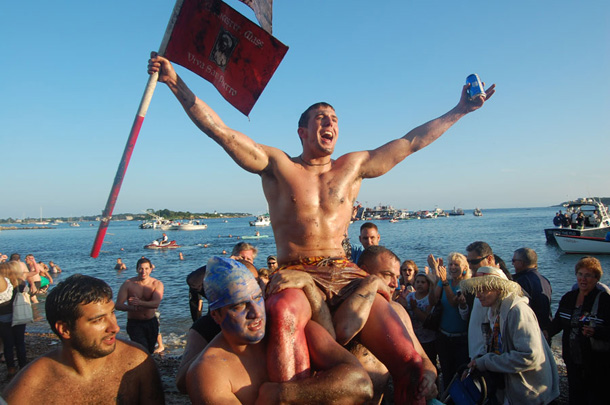
My friend and fellow blogger Greg Cook seems to be branching out from art criticism to the thing itself - or at least that's how I feel after checking out a recent post on his blog, The New England Journal of Aesthetic Research. Above and at right are two images from a set of photos he took up at the St. Peter's Fiesta in Gloucester a week or two ago.

You see in addition to being a damn good critic, Greg's a kind of social documentarian; he loves stalking the natives - the kind you don't find at art galleries - and photographing them in their natural habitats, particularly when they're celebrating, or improvising their own un-self-conscious aesthetics. Which explains how Greg went all Margaret Mead on Gloucester, capturing several quite striking images of a fiesta that's half religious festival and half wacky frat party (the triumphant young gentleman above had just won the "greasy pole contest"; that's St. Peter at right, presiding over the fireworks in his honor). 

Greg has always had an eye, but these may be his best work yet - I feel like I've actually been to the fiesta myself, and several of the images are emotionally powerful yet quite complex in their bemused detail.  I'm hoping an exhibit - or maybe even a book - will eventually come out of his predilection.  (Only I've told him he can't review it himself.)

Tuesday, July 5, 2011

Yes Virginia, British theatre can suck, too

 The Cherry Orchard gets lost in wheat, fields of wheat at the National Theatre.

The simulcast phenomenon has been widely praised for bringing world-class performances to the suburbs and the sticks; these days, for instance, opera lovers around the world who can't afford a trip to New York (or Met ticket prices) can catch cutting-edge productions at their local mall.  Likewise theatre lovers in the States can now sample the best of the British stage via the National Theatre's popular simulcasts (which are currently exclusively shown at the Coolidge Corner).

Or so the thinking goes.  As Hub Review readers know, I'm on the fence when it comes to simulcasts. I, too, enjoy catching great opera and theatre affordably; and I'm intrigued by the epically-scaled, yet still-theatrical quality that the best simulcasts (such as Helen Mirren's Phaedra) have had.

The trouble is that the actual productions being simulcast don't always turn out to be so great. In fact plenty of what I've seen bounced off the satellite from London or New York has been fairly mediocre; I've even walked out of more than one of these broadcasts.  As I did last week, at the National Theatre's simulcast of The Cherry Orchard, which wasn't the worst production of the Chekhov classic I'd ever seen, but was certainly a contender in the race for the bottom of that particular heap.

Yet it came garlanded with accolades.  Starring stage veteran Zoe Wanamaker, and directed by NT mainstay Howard Davies - who has helmed a series of highly-praised productions of Russian classics translated by his Cherry Orchard collaborator, Andrew Upton - the production was launched with great fanfare, and the British press pretty much fell into line behind it (the Sunday Telegraph gave it five stars, the rest of the print press generally gave it four - although there were murmured dissents, often in, yes, the blogosphere.  Why, again, do we think bloggers are less insightful than print critics?  Oh right - because the print critics say so!)

Yet despite all this advance ballyhoo, from the start of last week's simulcast I smelled a disaster in the making.  Bunnie Christie's set was so dilapidated you half-expected the family manse to collapse at intermission, and you quickly realized that translator Andrew Upton had decided to openly politicize the play while "updating" it in a crudely anachronistic style.  These Chekhovians may have been wandering around in period dress, but they bickered about "making 25 or 30k a year," shouted "Bollocks!" at each other, or  "I've told you so a thousand bloody friggin' times!" Meanwhile the political speeches in the play were extended and none-too-subtly rewritten as full-throated calls-to-arms.  This Cherry Orchard wasn't merely politically prescient; it was, instead, an overt pamphlet - for a revolution that utterly failed, btw, read in a nineteenth-century ruin but in a twenty-first century idiom.  The thing was a conceptual car crash of truly epic proportions.

But judging from my personal experience of Chekhov onstage, turning the master's warhorses into political or artistic hobbyhorses seems to be a great temptation.  One reason that the ART has also always sucked at Chekhov is that its directors are likewise determined to present the playwright as the happy herald of  revolution - any revolution; if not actually the Bolshevik revolution, then the Symbolist revolution, or the Suprematist revolution, or, believe it or not, even the Guns N'Roses "revolution."

This kind of thing is, of course, a complete violation of the subtle, skeptical balance that Chekhov is all about - plus it's just deeply stupid - so stupid I always thought you'd have to be pickled in Harvard's special brand of arrogance to imagination it could count as intelligence.  But I was wrong!  It turns out the folks at the National Theatre are just as dumb - or just as arrogant (or both).  Perhaps they felt that given the current destructive conservative mania on both sides of the Atlantic, the times called for a more politically pointed Chekhov; but alas, the Russian master never rallied anyone to the barricades, and trying to push a Brechtian template onto The Cherry Orchard isn't going to change a single vote in either the House of Commons or Representatives.

Oh, well; while the show was a mess conceptually, there were some bright spots in its cast: James Laurenson was everything he should have been, and more, as Gaev, and Sarah Woodward turned the weird Charlotta into a funny comment on the other characters' tortured self-consciousness.  Pip Carter made a solid Yepihodov, and a few other actors struck sparks here and there - Tim McMullan had his moments as Pischik, and Mark Bonnar started off well as Trofimov, but eventually proved far too studly and vigorous for the role (he wasn't helped by the fact that Upton extended his armchair-socialist speeches into fist-pumping harangues).

In the end, however, you can't pull together a Cherry Orchard without a solid central ensemble, and here the National Theatre mysteriously came up a cropper.  Zoe Wanamaker's impishness undercut Ranevskaya's famous pathos, and she couldn't make much sense of her (admittedly sudden) swings in affect.  At the same time she certainly seemed no more aristocratic than the low-born Lopakhin - here played by Conleth Hill, who threw off some funny asides at first but seemed to grow more superficial by the minute.  Likewise Claudie Blakley made little or no impression as his supposed intended, Varya, while as her younger sister, Charity Wakefield was an emphatic blank.

Sigh.  I confess this is one of those rare times when I'm penning a review without seeing the entire show - but at intermission, I realized I'd simply had enough of all these people: bad translation, variable acting, nutty set - there was no way this baby was pulling out of its nose dive, and frankly, I felt life was too short to stick around.  So I told my friends to email me if the show improved in the second half, and I'd hold off on a review till I'd caught the encore.  But the next day I saw the sad email: "You were so right.  It only got worse!"

Well, that saves me a trip back to the cinema.  But it doesn't help with my worry over the underside of the simulcast phenomenon: how does one push back against it critically?  How does one convince an audience that what they just saw wasn't really much good, and that in fact there is far better to be seen locally (as in the Huntington's Cherry Orchard of three years ago)?  Sadly, the simulcast phenomenon could sometimes represent yet another way that global branding trumps local quality.

Sunday, July 3, 2011

Good news from ArtsEmerson - and is Harvard's "populist" really all that popular?

The news is good from ArtsEmerson, even if the Globe doesn't want you to think so.


The Boston Globe includes an interesting statistic today - you have to look for it, though; it's buried in a hatchet job on ArtsEmerson by Laura Collins-Hughes. The article is clearly a response to the meme I first posited last fall - that ArtsEmerson's director, Robert Orchard, had pulled the intellectual rug right out from under the now-"populist" ART (his former employer).  By now I'd say that's the conventional wisdom - if you want to go to a baseball game, a strip club, or a Journey concert, you go to Harvard.  But if you want challenging theatre - that is, if you like Shakespeare with the words - you go to Emerson, which in one incredible year presented the dazzling millennial circus Psy, the hilarious Fräulein Maria, the stunning Aftermath, a brilliant social documentary by The Civilians, and a superb production of The Cripple of Inishmaan by the Druid Theatre. For a time, in fact, it seemed that everything Emerson touched was turning to gold - but of course, a few bombs eventually fell (like the Abbey Theatre's ridiculous Terminus), and the "big name" events, such as the visit by Peter Brook's troupe, or the tour of F. Murray Abraham's Merchant of Venice, turned out to be worthy, but slightly mixed, bags.

But you can't have everything, and even with those disappointments I still stand by my prediction of a few months back: the ArtsEmerson inaugural season did indeed prove to be the greatest theatrical season this town has seen in thirty years.

But anyway, back to why I'm jumping up and down this morning.  The Globe clearly has it in mind to question the staying power of ArtsEmerson - word on the street has it that several of their projects lost money, and judging from the announcement of their next season, they've slightly trimmed their sails.  Under pointed questioning, Orchard dodges the specifics of the program's finances, although he admits he'll be concentrating this year on fund-raising.  Still, he hasn't trimmed his seasonal sails by much, and even though ArtsEmerson is clearly relying on big-name draws from the BAM circuit (like John Malkovich) to boost their profile, they're also bringing back Kirk Lynn of the Rude Mechs and the great Civilians.  They're also betting on the super-sexy Circa from Australia, who blur the line between circus and dance (and whom I caught in Edinburgh a year or two ago; don't miss them) - and are finally bringing in (they promise) current Met bad-boy Robert Lepage.  And there is sure to be at least one more great surprise lurking among the acts I don't know.

But how popular will such a line-up be?  In other words, can Boston really support this much theatre for smart people?  Or do we need a little dumbed-down Harvard sugar - or scotch - to swallow what's good for us?

Well, as it turns out - the numbers are kind of encouraging.  We're not as dumb as Harvard and the Globe wants us to believe we are.  ArtsEmerson sold around 50,000 tickets last year, it turns out - trailing, it's true, the Huntington (at 106,000) and the ART (at 82,000).  And part of ArtsEmerson's box office was no doubt due to the drawing power of F. Murray Abraham (whose performance as Shylock was actually disappointing, but if he pays the bills, invite him back!).  Still, 50,000 tickets actually strikes me as a respectable number for a maiden season largely populated with unknowns.  And the news gets better when you look at the "membership" numbers - in one year ArtsEmerson has signed up 4,000 people.

Now an ArtsEmerson "membership" isn't nearly as large a financial commitment as a subscription would be.  Still - having 4,000 people sign up for anything cultural is a very good sign in this town.  (Compare to Celebrity Series's 2700 subscribers.)  Plus, ArtsEmerson members in many cases look like new converts to the arts - two-thirds of them don't overlap with any other arts series.  (Yes, you read that right, startling as that number is.) And the news gets better - the ART can boast far less sustained interest from its patrons: it only has 2600 subscribers for those 82,000 tickets sold.  Indeed, the real news in the article is the following statistic - the Huntington has nearly four times as many subscribers as the ART does (a whopping 10,000 subscribers!).

When I read that, I suddenly felt another rug being pulled right out from under Diane Paulus & Co.  I suppose the evil Paulus is up where she needs to be in terms of single ticket sales - but let's be honest, take out the horny kids who hit The Donkey Show over and over, as well as all of Amanda Palmer's Facebook friends, and I'd bet you good money the ART isn't selling many more tickets than ArtsEmerson did in its inaugural year (and maybe only two thirds of the Huntington's haul).  And that's even with the advantages of Harvard's incredible brand and social reach, along with really constant promotion in the press, and open threats to local critics who don't toe the line (as well as a slew of awards from frightened scribes who know better than to cross the ART's dragon lady!).

And yet with all that, it's clear Paulus isn't really getting any kind of traction; she's not building anything.  The young audiences the aging diva so covets aren't really committing to her vision.  I mean, I knew the Huntington was more popular than the ART - although you never read that in the paper - but still, Peter DuBois has gotten four times the commitment from the community that Paulus has?  That's kind of incredible; I've been raving about them recently, but even I'm kind of surprised.  I'd say that's Boston theatre's best-kept secret.

The excuse for Diane Paulus's meagre artistic achievement, of course, has always been that she's a "populist," that, as Paulus apologist Christopher Wallenberg put it in a recent article, her "whole mission" is to follow the audience.  (That's right: avant-garde theatre that follows the audience.  Can you spell o-x-y-m-o-r-o-n, Chris?)

But what do you have when your "populism" isn't really all that popular - when you're a series of flashes in the pan, when people check you out because they've heard you're dirty and loud, but then don't come back?  Well, I know what people like Christopher Wallenberg and Ed Siegel will prescribe - Harvard needs more Red Sox, more tits and ass!  Because after all, the millennials just don't commit, do they; they're so cheap they won't even pay for their favorite albums; so how could you expect more than an anemic subscription base for an organization targeting them?  You have to string the kids along from thrill to thrill, the way a video game or a porn site does.

There's some truth to this - but it's not the kind of truth that really helps Diane Paulus.  Because in the end memberships and subscriptions do point to the long-term health of an organization.  And somehow it seems the Huntington and ArtsEmerson, which are facing the same environment as the ART, are doing better at getting folks to commit; indeed, ArtsEmerson seems to be much better at pulling new converts into the high-culture fold - supposedly Paulus's specialty - and with real, not fake, art!  Which maps to a disconnect I've already perceived between what I hear informed Bostonians say and what I read in the print press; I never run into anyone, frankly - outside the Harvard/media echo chamber, that is - who takes Diane Paulus or the ART seriously.  When people say they like a Paulus show, it's always prefaced with an embarrassed little laugh that tells you "I know it was kind of stupid, but I'd drunk a little too much, okay?  So I kind of liked it." I'm beginning to realize that somewhere deep inside, believe it or not, people still know that Amanda Palmer can't sing, and that Aeschylus didn't write a rock opera, and that The Donkey Show isn't Shakespeare. And I believe Paulus's numbers reflect that.  And so I think - or at least for the first time I hope - that in those numbers I can finally see the light at the end of a long tunnel at the ART.

Saturday, July 2, 2011

Kelley Donovan goes casual

Last weekend I had the opportunity to catch up with Kelley Donovan and Dancers at the Dance Center in Cambridge. Donovan is a leading light of the local dance scene, and performs regularly both here and in New York; it seems she has been poised for a "breakthrough" in both locales for a while - without, unfortunately, quite yet achieving it.  Unsurprisingly, last Saturday's recital gave some indication of why she deserves to indeed break through - as well as what may still be holding her back.

I confess I felt a bit like an interloper at the event, which was clearly a kind of fundraiser amongst friends, and thus had a casual atmosphere, with Donovan herself wandering around in her warm-ups before the show, greeting folks she knew.  Still, I'd been invited - after Donovan had belatedly read a positive review I'd given her almost a year ago; I was amused to note on her company website an endearingly blunt post that read, "On another note, I found this blogger review from something called The Hub Review from the ICA Boston show last fall! I did not even know it was out there til a week or so ago."

(I am currently considering changing the title of this blog to Something Called the Hub Review, btw.)

At any rate, the program turned out to be a little casual and funky, too; the sound system needed adjustment at the beginning, and not all of the performances were quite ready for prime time.  This was most noticeable in the opening piece, the swirling Within and Between, a 2009 work set to a chunk of Philip Glass; dancer Anna Kharaz confidently gave a fully-fledged performance, but her partner, Sam Wilson, seemed to be newer to the steps - and given that the piece is a kind of out-of-synch fugue for two, this was sometimes a problem.

Next came the premiere of Edge Closer, choreographed by one of Donovan's dancers, Lucy Considine, which purported to represent "the ongoing process of acceptance of life events."  Okay - I guess we don't need any specifics!  As essayed by an energetic cohort of young women, the dance showed ambition and some promise, but never quite cohered into an individual statement.

There was more punch to the premiere of Oh, beautiful, by another Donovan dancer and aspiring choreographer, Angie Hartley.  Here - to the warbling of Elvis Presley at his most "patriotic" - we watched as a woman (Hartley) crawled desperately toward a serene Laura Murphy, done up as a goddess reminiscent of the Statue of Liberty (or maybe one of those "Freedom" statues atop some Confederate statehouse).  Hartley's movement had a raw, needy physicality- which played nicely off Murphy's bemused cool; in her notes, Hartley explained that the work was "an exploration of the romanticism of nationalism," but it looked to me more like an exploration of the need for a lip-lock with America (which would have been fine by yours truly).  Given the lack of said lock, I'd say the piece needs a bit more of a choreographic climax - still, it was certainly heart-felt, and memorable.

Finally came more of Donovan's own contributions - the solo Vigilant and the group piece What is Stable Shifts, What is Solid Slips (image at top). Vigilant played as a short course in Donovan's favorite choreographic tropes - the keystone of her style is a kind of sinuous pivot that's both sensuously fluid and yet rooted to the floor (if airy elevation is fundamental to ballet, than the ground itself is what grounds modern dance).  Again, I felt an intricate structure but not too much development - and I questioned whether Donovan's vocabulary actually communicated an inner state of "hyper-vigilance," as her program note stated (she seemed to be in something more like a trance).  Similar issues hovered over the more ambitious What is Stable Shifts - and the piece seemed almost too elaborate for its spare Morton Feldman score.  Still, it featured committed, calmly detailed work from a large ensemble - who expertly conveyed the muted lyricism of Donovan's layered variations - and so proved the most satisfying performance of the evening.

In the end, said evening impressed me in many ways - and certainly I'm still interested in Donovan - but I also left feeling a little frustrated.  A deep problem for many local choreographers, it seems to me, is that they're stuck in a dated abstract-art mentality - and Donovan, I'm afraid, has a bit of this mindset. She has her own distinctive vocabulary - which is remarkable in and of itself - and oddly, a good sense of structure; but that doesn't seem to lead to a complementary sense of development.  And she tends to avoid actual conflict (or actual sex) in favor of "ideas" that even at first blush sound a little dull (in that familiar Cage-by-way-of-Duchamp kind of way). Take What is Stable Shifts, What is Solid Slips - uh, when I was twenty I probably would have found an "investigation" of equilibrium in the abstract really interesting; but today, not so much.  Instead I wonder why, with so many women on stage in so much local choreography, I see so little girl-on-girl action. (I wonder the same thing about our local theatre, but never mind.)

Now by that I don't mean some sort of lesbian fantasy devised by Diane Paulus and Randy Weiner for the Playboy Channel (and later PBS); I mean something with actual emotional connection rather than merely the consideration of emotional connection, something that genuinely heats up. Or something that gives us some sense of social interaction onstage - to my mind, dance should be a social event for the dancers, but too much of postmodern choreography is by default about isolation (and thus is itself isolating).  In the end, I think Donovan has the talent to transcend these limits of the arthouse dance scene - and I hope she does so soon.