I'm sure you've already heard the "hook" of the Nora Theatre's production of Eugene O'Neill's A Moon for the Misbegotten (sorry, had to pull the photo for the show, because its photographer - Elizabeth Stewart - has been a huge pain in the ass). And Jesus, Mary and Joseph, the Irish lass at the center of the piece is played by an African-American (the talented Ramona Lisa Alexander). What is the world comin' to, etc!
Well, I don't know the answer to that question, but as long as the Nora is happy to cast A Raisin in the Sun with white folks, I suppose there's no problem with this approach (although somehow I don't think they are). As Hub Review readers know, I'm a strong advocate of color-blind casting in general; still, some plays are so associated with a certain culture or milieu that one does raise an eyebrow at fiddling with that context. And O'Neill is very specific about his context here - an Irish farmstead in 30's Connecticut - and director Richard McElvain seems to have no interest in tweaking that set-up in the least.
Although of course it's fun that a black lady should be playing one of the Irish, I suppose, many of whom in times gone by were notorious for their racism; and it was definitely a kick watching Terry Byrne, in the pages of the Globe, do back-flips to show how down she was with all this, after years of bowing and scraping to South Boston in the pages of the Herald. Meanwhile the fact that Ms. Alexander was playing against Will McGarrahan, a stalwart of the gay-oriented SpeakEasy Stage, seemed like so much icing on the multi-cult cake - and left me hoping the supporting cast might be filled out with Asians and Latinos, all sporting accents from Killarney.
But no such luck. And alas, Ms. Alexander is actually not all that sure of her accent, nor does she have an abundance of chemistry with Billy Meleady, the real-life Irishman who plays her Da (perhaps partly because Meleady doesn't really have as much scabrous fun with the part as he might). For much of the production's first half, it's only intermittently engaging, and seems like hardly a patch on the powerful Merrimack version of a year or two ago.
But Ms. Alexander has a lock on at least one aspect of the role - she's got the earth-mother thing that the play demands going big-time. Whenever Alexander braces herself, hands on hips, legs planted far apart, those legs seem to stretch right into the ground - she looks rooted; and when she embraces her drunken, fallen suitor, you can indeed believe that poor Jamie Tyrone (and poor Eugene O'Neill) might have found solace in her arms. Meanwhile McGarrahan goes to very dark and desolate places as the ruined, alcoholic, sacrilegious Jamie, and he does so almost off-handedly, so that his performance, though perhaps lacking in believable sexual bravado, slowly becomes intensely poignant. And Alexander matches him, beat for beat. By the time the sun rises on this long, perhaps-redemptive night (an effect brought off beautifully by lighting designer Margo Caddell), Alexander and McGarrahan have taken us to the heart of the matter, as it were. Which is where any production of A Moon for the Misbegotten wants to end, however it gets there.
Showing posts with label Nora Theatre Company. Show all posts
Showing posts with label Nora Theatre Company. Show all posts
Thursday, November 4, 2010

Friday, June 18, 2010
Lady with All the Answers doesn't really offer any

Stephanie Clayman as Ann Landers. Photo by Elizabeth Stewart.
The Nora Theatre Co.'s The Lady with All the Answers, at the Central Square Theater through June 26, purports to be a biography of "Ann Landers," the pseudonym for Esther Pauline ("Eppie") Lederer, the Chicago sage who via her ubiquitous advice column led an ongoing national salon in the pages of the press for 47 years.
Lederer's long success in the role of "Ann" (she was so popular that identical-twin-sister "Popo" soon carved out a competing chunk of turf as "Dear Abby") wasn't much of a mystery. She may have been no student of the human soul, but Eppie had a keen eye for the emotional (and moral) bottom line - you couldn't pull one over on her; and of course she had an army of experts on call who could advise on the technicalities of virtually any topic. She also had a style - a punchy, wiseacre chirp with an ethnic lilt that had somehow been drained of all ethnicity, and was spiced instead with her own brand of 40's slang: "Bub, you've got a geranium in your cranium!" was a typical line.
Did anyone ever actually talk like that? I mean besides "Ann"? Well, apparently Eppie did; or so playwright Rambo would have us believe. He doesn't really try to crack the veneer of Lederer's linguistic vim and vigor, but does a pretty good job of capturing its cadence, and making it sound roughly like conversation. Although in The Lady with All the Answers, Eppie's the only one talking; the play's conceit is that she's holding court in her plush Chicago apartment (perfectly rendered in Louis Quinze and Chagalls by designer Brynna Bloomfield) as if it were a talk show set, chatting across the fourth wall to the audience about this or that famous letter or opinion. But at the same time, she's trying to crank out her most famous (and most personal) column - the one that announced her divorce from Budget Rent-a-Car bigwig Jules Lederer, her husband of 36 years. Yes, public face and private heartbreak. Sexual betrayal - and how to hang the toilet paper! This double device is unwieldy at times - intermission arrives because Eppie declares she needs a bubble bath - but to be honest, it does kind of capture the column's funny yin-yang tension between tragedy and trivia.
But the playwright treads so lightly in Eppie's private life that we actually learn none of her secrets. The script's raison d'être would seem to be to get behind that famous column - but Rambo steadfastly refuses to do so. We learn hubby Jules was having an affair "with a woman younger than his daughter" (that daughter would be Margo Howard, who kept the advice dynasty going with "Dear Prudence"), which meant the marriage was over. But we do wonder why, exactly - Eppie was constantly advising other couples to go through counseling, patch things up for the sake of the children, try to learn to trust each other again and see the marriage through. So why couldn't she take her own advice?
Likewise her famous (and utterly understandable) feud with "Dear Abby" is acknowledged, but given the comic brush-off (after a reported five-year silence, the two did reconcile, below). We do learn a few things about Eppie that hint at a powerful, and possibly mercurial, personality - such as the fact that she dropped a standing fiancé to marry the handsome Jules (whom she met while shopping for her wedding veil!). Perhaps Eppie was more demanding and pampered (all those bubble baths!) than she, or Rambo - or perhaps Margo Howard, whose protective presence seems to hover over the play - lets on.
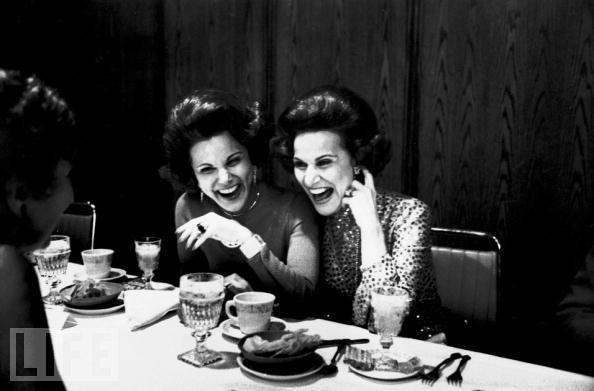
"Eppie" and "Popo" - a.k.a. "Ann Landers" and "Dear Abby."
On the plus side, we also get a sense of Lederer's considerable political energy (she was a liberal Democratic operative, and her connections to many of her experts came from her friendship with Hubert Humphrey), which you'd think could open up for us a whole new perspective on "Ann Landers." After all, Eppie was hardly politically mainstream; she was progressive, and Jewish, and pretty much a proto-feminist, all while insisting she was a "square" with a WASP name out of Leave it to Beaver. Playwright Rambo doesn't really limn these contradictions, but does perhaps his best work while detailing Lederer's frustrating campaign against the Vietnam war. Her change of heart over, and eventual championing of, gay and lesbian issues is likewise quite touching. Eppie was certainly on the right side of most of our political struggles, even if her commercial connections and general social M.O. left many progressives and feminists sneering.
Some of the edge of this material is lost, however, in the smooth bubble bath of nostalgia at the Central Square Theater, where Daniel Gidron has directed the play as a light crowdpleaser - which is probably precisely how it was intended. And it is entertaining - and even moving in its more-political segments. I just think it could have been a little bit more. As Eppie, actress Stephanie Clayman is certainly likeable and full of pep - she earns the right to wear that famous perm. And she nails a Midwest accent so eccentric something tells me it's drawn from recordings of Lederer herself. But Clayman doesn't really push the envelope when it comes to the deeper feelings that must have tugged at Eppie while writing that fateful column; she pauses and sighs a lot, it's true, but once the column's done, and read aloud to daughter Margo, Clayman hardly seems emotionally exhausted; instead, she actually lets out a great big yawn. Oh, well, so much for Jules, off to bed!! This probably squares with the expectations of the audience - which really wants just one more Ann Landers column, rather than an investigation of the whole phenomenon. But anyone who thinks The Lady with All the Answers has answered any of the open questions about Eppie Lederer has a geranium in his - or her - cranium.
Friday, March 12, 2010
Sophie's choice

Craig Mathers, Anne Gottlieb, and Marianna Bassham try to breathe life into Not Enough Air.
Watching Becky Shaw last night at the Huntington, I was struck by how playwright Gina Gionfriddo kept tossing little poisoned darts in the direction of the feminine victimization fetishes taught at Brown University (and really the entire academy). Would she could have also taken aim at Not Enough Air (through Sunday at the Nora Theatre Company), the disjointed update of Sophie Treadwell's Machinal that the critics did hand-springs for, but which left me (and the audience I saw it with) pretty cold.
Indeed, playwright Masha Obolensky (who's at Northeastern, not Brown, but what's the difference) could crib more than a few notes from Gionfriddo - that is, if she wants to really get at what she's pretending she's interested in: the dangerous psychological material that the notorious Ruth Snyder murder trial dredged up for playwright/reporter Treadwell.
That's right - Not Enough Air is a play about writing a play, which I guess is its excuse for being kind of a conceptual mess. But that's probably what comes of caring more about your theatrical effects (none of them particularly new) than you do about your characters. Treadwell's Machinal, though rarely produced today, made a Broadway hit out of the Snyder murder trial by turning it into an expressionist meditation on the entrapment of women in marriage and, you know, society and stuff. Thus Not Enough Air aims to be a post-expressionist (or post-meta-expressionist) meditation on an entrapped woman writing about the entrapment of women. Or something like that.
 The problem, of course, is that Ruth Snyder (at left) wasn't really trapped, and neither was Sophie Treadwell. Indeed, it's telling that Ruth's murder of her husband (with the help of the lover she browbeat into the job) inspired not just Machinal but also James M. Cain's The Postman Always Rings Twice and Double Indemnity. These different takes on the basic facts operate like opposed stars: to Treadwell, Snyder was a victim of a masculine power structure machine-like in its oppression of women ("machinal" is French for "mechanical" or "automatic"). To Cain, she was a brilliant, diabolical seductress. Both are essentially paranoid (or maybe hysterical) extrapolations of an almost amusingly tawdry murder case. The real Ruth Snyder was rather obviously neither a crushed violet nor a Venus flytrap; she was, instead, cruel, ruthless, and rather stupid. (Her hilarious missteps and inadvertent confessions basically sealed her and her lover's fates.)
This doesn't mean, of course, that Treadwell's obsession with her isn't interesting as a dramatic subject; the trouble is that Obolensky doesn't know how to dramatize said subject. Instead for about an hour we get poor Anne Gottlieb (as Treadwell) supposedly getting sucked into the Snyder case, but really just wandering through a gauntlet of popping flash bulbs, loud sound effects, nasty phalanxes of company men, and shadowy, noirish tableaux. We get the sense that we're supposed to be saying to ourselves "OMG! IT'S LIKE A MACHINE!" over and over again, but we soon get really tired of saying that and begin to wonder when the actual play is going to start.
To be fair, something dramatic does get started in the second act, when Obolensky trains her sights on Treadwell's efforts to conjure her own characterization of Snyder in the play-within-the-play. Briefly, something seems to be at stake for the characters, at least in the wary, menacing dance between Gottlieb and the ever-terrific Marianna Bassham as Snyder's fictional double. But the excitement these talented actresses generate when left alone together soon dissipates. Obolensky seems to want to convey that by opening up the Pandora's box of her repressed feelings about the "trapped" murderess, Treadwell destroyed her open, quasi-bohemian relationship with fellow journalist George Stillwell (the wasted Craig Mathers). This is a promising idea, but soon we feel ourselves filling in all the dramatic blanks for Obolensky on this score; the playwright simply can't seem to get inside Treadwell's relationship (or give poor Stillwell much of a characterization). And at any rate, Machinal didn't exactly turn Treadwell into a great artist (the rest of her oeuvre is hackwork); so we wonder if, in the end, losing whatever she had with Stillwell was worth that one success. Not that Obolensky would ever go there; instead, we're soon back to political stick figures, scenic out-takes from Chicago, and meta-theatrical constructs. Every now and then, I hoped the cast might just break into a chorus of "He Had It Comin'," but no such luck. What was most touching about the production, in fact, was charting its rise and fall on poor Anne Gottlieb's face: first she looked lost, then thrilled to be playing against Bassham, then lost again. This fine actress deserves better.
Oh, well. Needless to say, director Melia Bensnussen, who's made a specialty out of pounding a politically-correct template down onto Shakespeare, was pretty much indifferent to whatever emotional connections Obolensky hints at between men and women. Instead, as is her wont, Bensnussen emphasizes just about everything that's dramatically weak (but politically au courant) about Not Enough Air. The supporting cast - a roster of Boston's best actors - dash about with more than enough energy to put over the director's puppet show, but it's kind of a lost cause. David Remedios's sound design deserves praise, and John Malinowski certainly gives the lighting grid a workout. Beyond that, though, there's really not enough drama in Not Enough Air.
Wednesday, October 14, 2009

Joe Lanza, John Kuntz and Michael Balcanoff in The Caretaker.
The Nora Theatre's current production of The Caretaker (through November 1 at the Central Square Theater) is in many ways a worthy piece of work. Director Daniel Gidron has (wisely) decided not to attempt to "update" the play that first brought Harold Pinter international attention; indeed, within the production's budget, Gidron and his designers seem to have attempted to replicate as faithfully as possible the circumstances of Great Britain in 1959, the year of the drama's debut. The accent work in the production may be only adequate, but it's still good enough to not distract; and the acting (particularly by John Kuntz) is thoughtful and detailed, and at times quite absorbing.
Yet despite all the care taken with The Caretaker, the mysterious sense of unknown danger that once defined Pinter - and which I am old enough to remember from productions I saw in the 70's - has gone missing from this version. And the Nora is hardly alone in its inability to conjure that once-famous atmosphere of threat. The A.R.T.'s No Man's Land from two seasons ago felt similarly flat, and its Birthday Party from a few years before that had been faintly ridiculous. Other, smaller local productions that I've seen in recent years - of One for the Road, or The Lover, for instance - have been similarly threat-free. Indeed, as I watched The Caretaker I realized that I hadn't felt a classic Pinterian chill from a new production in perhaps two decades; you might have to go all the way back to the late 80's, and the Huntington's production of The Birthday Party, to sense the playwright's old black magic. And this issue couldn't be laid at the feet of directorial interference; true, at the A.R.T. director JoAnne Akalaitis had essentially parodied The Birthday Party, but other recent productions had been quite seriously conceived, and Daniel Gidron clearly intended this Caretaker to be as close an approximation to the original production as possible. (Indeed, a clip from the original film, below, reveals that even it is none too disturbing today.)
A sequence from the 1963 film of The Caretaker, with Donald Pleasance and Alan Bates.
So is Pinter "dated"? And if so, why? And how might his seemingly lost immediacy be recaptured?
Of course what's clear at once about Pinter is that if he is dated, it's due to his incredible success and influence. Listening to The Caretaker, in fact, I was struck again and again by how his voice has become the lingua franca of so much pop culture. Saturday Night Live appeared just as his output began winding down, and its skits were often rife with light, dumbed-down riffs on his central tropes. Then came Quentin Tarantino, whose dialogue is essentially a drive-in-movie version of Pinter's comedy of menace, re-fitted with fresher pop references (and goosed along by literal threats of torture and rape). But a funny thing happened to the Theatre of the Absurd once Quentin Tarantino and Lorne Michaels got their hands on it: it went meta, and lost its powers of critique.
But then today we don't have "irony" anymore; we have meta-irony instead. The ironic stance is no longer a challenge for an audience - rather it's an escape hatch. Culturally we're all channel-surfers, no longer embedded in the consensus that Pinter was savaging in 1959; belief in God, normative heterosexuality, the oppressions of bourgeois capitalism, the threatening police state - to today's audiences, all these things are essentially avoidable via the all-too-aptly-named "remote." And "irony" is the knowing lubricant by which we slide past each other in what remains of our cultural meeting-places.
The problem for Pinter's legacy is that while his manner has become ubiquitous, nothing coherent has replaced his initial target. Thus his stance has become comforting rather than disturbing - indeed, the audience I saw The Caretaker with responded warmly to the bizarre non-sequiturs of the leather-jacket-clad Mick, who rattles on about interior decorating while hinting at violence. The character's dislocations of meaning were funny and familiar; we took him as one of us, our theatrical avatar.
And we do so because we no longer identify with Pinter's benighted victims, but instead feel secure in our superiority to them as they grope around (sometimes literally) in the cultural dark. Unlike them, we're sure of our powers of control over our separate lifestyle-niches; if worse comes to worst, we don't have to grapple with existential questions, we can simply go shopping for a new identity.
Against this deeply cynical, but utterly self-amused alienation, Pinter has little or no power. Indeed, what's striking about his current cultural position is that the playwrights he was thought to replace, like Noël Coward and Terence Rattigan, have seen a renaissance in interest, as their durable virtues match well to a certain nostalgic demographic. In a word, the well-made play is hot, the Theatre of the Absurd is not.
But how to restore Pinter's former potency? Ah, there's the rub; the decline of "monoculture" may have dealt a greater blow to the absurdists and existentialists than it has to the bourgeoisie (which, in case you haven't noticed, is flourishing). And so far, at least, no one has managed to crack the carapace of self-satisfaction one senses in our Gen-Y "glibertarians" - they're not shivering in some Beckettian wasteland, struggling with the bleak truths of the absurdists; they are, instead, snug as bugs in their respective digital rugs. And the idea of using absurdity to attack their own assumptions strikes most of them as, well, simply absurd; indeed, their strategy of simultaneous disconnection from, yet accommodation to, the social and political world may make them all-but-impervious to theatre as a mode of communal critique. Thus any clear-eyed observer must inevitably face the underside of all those calls to draw more young people into the theatre: if we do so, we may inevitably compromise what theatre still, just barely, is.
Of course all's not quite lost, and even this production of The Caretaker offered some insights into how Pinter's legacy might be kept alive. The production's central problem lay in the performance of Michael Balcanoff, as the tramp who tries to destabilize, but then is victimized by, the power relationship between two mysterious brothers (Joe Lanza and John Kuntz). Balcanoff was a convincingly scruffy, homeless gentleman, but was unable to insinuate much in the way of either seedy subservience or indeterminate identity. He was a bit better once his own sense of power began to inflate, but as a particularly destabilizing form of Pinterian threat, he still fell short. Likewise, Joe Lanza brought little sense of sadism to the preening, malicious Mick, although he did, as expected, make the character's long flights of fancy quite funny. It was John Kuntz who made the production memorable, even if at first his take on the brain-damaged Aston was almost too recessed to be truly theatrical. But in his long solo in the second act, in which Aston recalls how he came to be so mentally impaired (unlike Beckett's Lucky, Aston's mind was violated, a key difference between Pinter and his great mentor), Kuntz was superb - quietly, but meticulously, intense. And briefly, the cold fires within the play flickered to life.
Saturday, June 6, 2009
Back to the future
 You could be forgiven for abandoning the Nora's new production of On the Verge (at left) at half-time - because at that point Eric Overmyer's script seems too postmodern-ly twee, too drunk on its own Victoriography, and too dependent on dramatic filler (the abominable snowman even shows up). But stick with this wordy trek into nebulous metaphor. Because it's actually on the verge of cohering into a sweet, rueful piece of boomer nostalgia. And the able cast, which has a little trouble balancing their vocabularies with their characterizations early on, quickly relaxes (once given some real dramatic material) into a wittily poised ensemble.
Not that Overmyer's early scenes lack charm; it's just that charm is all they've got - and it wears thin over the course of an hour. We quickly get a handle on his affectionately patronizing attitude toward his Victorian ladies (Mary, Fanny and Alexandra), who venture into "Terra Incognita" armed with umbrellas, pith helmets, and apparently the Oxford English Dictionary (don't worry, the Nora provides a glossary for such tongue-twisters as "somnambulist" and "polytopian"). As this trio sallies forth, however, we likewise soon glean that they're actually venturing into Tempus, not Terra, Incognita - soon they're encountering such artifacts as "I Like Ike" buttons and stainless-steel eggbeaters, as well as seeming denizens of the future (all played by the energetically versatile Barlow Adamson).
Now perhaps at its premiere, the play's free-ranging conceptual conceit took longer to sink in; but after two decades of postmodern narrative pranks, we feel we're always a step or two ahead of these determined ladies. And the show's politics likewise feel - well, almost as antiquarian as their bloomers. For we also sense early on (indeed, as soon as that " Ike" button appears) that "the future" is going to turn out to be the American 50's or 60's. (After all, that's where all of history was headed, wasn't it?) And that the play's central concern is going to be these ladies' "liberation" in that great suburban tide of pop commerce and consumer choice.

The women of On the Verge - Alicia Kahn, Deanna Dunmyer, and Anna Waldron.
This perhaps explains the weakness of Overmyer's first act, with its amusing but extraneous cannibals and snowmen - he's just been biding his time before he got to his real material. And once there, he suddenly displays (with the help of Wesley Savick's likewise suddenly-subtle direction) a surprisingly rueful depth. The playwright has only superficially differentiated his characters until now - Mary's the plucky explorer, Fanny's the romantic conservative, Alexandra's the spunky young thing who wants to wear trousers. But at the top of his second half, his theme suddenly deepens, with the introduction of an Angel-of-Death-like figure called "Mr. Coffee," who hints at the sad underside of the explosion of "freedom" in the 50's. For our postwar commercial paradise essentially undoes the adventurous spirit of Fanny and Alexandra (just as it perhaps did our own) - they both settle down, in beehive hair-do's and capri pants, happy with the vast expanse of pop culture paraphernalia that slowly fills the theatre (and which seems to replace their enormous vocabularies). But inevitably, the sense of genuine romance that once animated them evaporates (indeed, Mr. Coffee's big news was that Fanny's lost husband had both betrayed her and subsequently died - and so soon she's curled up with some smarmy lounge singer). Only Mary hangs on to her sense of mission, eventually disappearing into an as-yet-undiscovered future - perhaps where America, too, hangs onto its progressive spirit, and Reaganism never happens.
So there's a kind of mournful critique buried in Overmyer's script that makes it worthwhile - and it's given its full due by the Nora cast. The stand-out here is Alicia Kahn, once a mainstay of the Wellesley Summer Theatre, and who I hope is on the verge of wider visibility in the mid-size theatre scene. Kahn's Fanny gets the best material, I suppose, but the actress also makes the most of it, hinting at a spooked sense of alienation beneath her slow embrace of 1955. Deanna Dunmyer and Anna Waldron remain perhaps slightly more imprisoned in Overmyer's Victorian ventriloquism, but both blossom to a lesser degree as the script marches onward. As their multifarious masculine consort/escort, Barlow Adamson keeps the manic energy level high, but only occasionally slips into caricature (as when he actually has to play a cannibal with gas - can you blame him?). Jacqueline Dalley's costumes are wittily appropriate, and Ryan McGettigan set is surprisingly evocative, while props coordinator Sacha Schawky has amassed a truly impressive collection of pop Americana. This is the strongest offering from the Nora I've seen for some time, and it's nice to see this theatre company get back on track.
Monday, January 12, 2009
How Not to Do Chekhov, Part II
Ah, hubris, c'est moi! Was it only on Saturday that I wrote of the Boston Art Theatre's Uncle Vanya, "Better you should try to convey Chekhov's century-old insights than re-enact the postmodern detritus of the 70's and 80's"? Yes, it was. But the Fates, I'm afraid, had a critical smackdown in store for me, via the Nora Theatre's traditional production of The Cherry Orchard (through February 1 at the Central Square Theatre), which, if anything, is even weaker than the Boston Art Theatre's pseudo-avant Vanya. Only the artistes at Boston Art at least have somewhere to hide - they can always pretend that only a stick-in-the-mud wouldn't like their disco ball, or their rock-and-roll interludes. The Nora, however, is stuck in a different way: when you attempt a masterpiece on terms that everybody understands, then everybody knows it when you . . . well, anyway. Sigh. Maybe I should have written, "If you don't have the resources to do Chekhov, better you should not do him at all!"
 Although it would seem the Nora does have those resources - there are plenty of talented local actors in this cast (Annette Miller and Ken Baltin, with Michael Balcanoff and William Young, at left), and they're being directed by Daniel Gidron, who teaches at UMass. Perhaps the show's under-rehearsed, or maybe Gidron and his translator, George Malko, have some rather odd ideas about the play (more on that later), but whatever the reason, things don't gel until well into the third act, and until then most of the cast is either coasting on broad versions of personae from earlier shows (Miller, Baltin, Balcanoff, Young), half-heartedly going through the motions (Daniel Berger-Jones, Elise Audrey Manning), or just don't know what they're doing (Darcy Fowler). There are two surprisingly solid minor performances - Mark Peckham's Pishchik, and Fred Robbins's Drifter - which with their internal authority and technical control seem to have drifted in from some other production. Which simply goes to show you that some actors can always find their way home in the dark.
So what went wrong? My gut is the blame is mostly Gidron's, if only because he's at the intersection of weak acting, an eccentric translation, and poor design. There are also hints that he's trying to force the play toward farce, which is what many academics insist it is (drawing from Chekhov's own outraged response to the "tragic" stylizations of Stanislavski). Now I'm not going to argue the play should never be funny - there's even a whole character designed (largely) as comic relief; and certainly it should never be played as "high tragedy." But I also have to point out, based simply on the experience of a lifetime of play-going and maybe a dozen productions of The Cherry Orchard, that the farcical approach tends to fall flat - particularly in the devastating last act. And I'm getting a little tired of professors telling me, based on "close readings" of the text, that the universal audience response to this play is somehow wrong. If they got out of the classroom and into the theatre more often, they'd change their tune (then again, maybe not). People cry at the climax of great productions of The Cherry Orchard for good reason - even though, yes, they understand the absurdity of its flawed characters; indeed, perhaps that makes them cry all the more.
Worse still, consciously farcical mechanics tend to look crass in late Chekhov - indeed, almost anything too-directly stated looks crass in late Chekhov - and this production makes a few such blunders; at one point Yasha actually screws Dunyasha on stage (I suppose so we can say "Dunyasha has done Yasha") - a crude bit of business that the actors seem as dismayed by as the audience. (This brought back terrible memories of the moment Arkadina suddenly showed her tits in the ART Seagull from the early 90's.) Meanwhile other rather important bits of business have gone missing (what happened to Charlotta's rifle, which should mirror Yepihodov's pistol?). And then there's the weird fact that the translation and the physical production are at cross-purposes. The performance style intermittently suggests modernist farce (as does the truly ugly set design) but the new translation is nevertheless flowery and antique. Meanwhile the costumes and props just look under-developed, while the lighting is precisely the wrong tint (a warm amber, even when everyone's talking about how cold it is). And the sound effects - where to begin? The Cherry Orchard includes two of the most famous sound cues in all theatre: the strange "sound of a string breaking in the distance" that's supposed to "fade sadly away" (here it sounds like somebody banging a gong), and the horrifying echo of axes falling on the eponymous, symbolic orchard (which here sounds like steam rapping in a pipe; at first I thought someone in the wings was knocking on the stage door).
Okay, enough. To be fair, things do move uphill as the show goes on. The play's first two acts depend on atmosphere, and a careful mosaic of implied theme and critique; Gidron and company blow that completely. But in the third act, when the estate is finally sold, and the actors have some action to play, they do get some traction, and things look up. Baltin hits some interesting, almost infantile notes in his announcement that he's bought the estate, and Mara Sidmore's bitter intensity as Varya pays off in her final disappointments. As Ranevskaya, Annette Miller has some line trouble, and comes off as too broadly needy in the opening scenes - and she never suggests the haunted quality the character should have from her entrance (those interested in a short course in how to play this woman should check out Charlotte Rampling in the Kakogiannis film version, which is out on DVD); but her style better matches the larger-than-life blows she absorbs in the later acts, and she's affecting in the finale.
Nevertheless, this only amounts to a general improvement to "passable." Perhaps, of course, the production could still slowly come together; as my friend said as we left the theatre, "Not enough money, not enough time." That's clearly part of the equation. Still, with even less money the kids in Vanya actually pulled off some better - and certainly more internalized - acting. Of course, those with little or no experience of The Cherry Orchard may find, as is often the case with great plays by great playwrights, that enough of the content comes over to make the experience worthwhile; on the other hand, one wonders why the Nora would attempt this classic in the shadow of Nicholas Martin's recent, masterful version at the Huntington (which, true, also suffered from a weak lead performance). Certainly the production limns no new insights into the question of whether the play is a tragedy or a farce. Even though there were times when I didn't know whether to laugh or cry.
 Although it would seem the Nora does have those resources - there are plenty of talented local actors in this cast (Annette Miller and Ken Baltin, with Michael Balcanoff and William Young, at left), and they're being directed by Daniel Gidron, who teaches at UMass. Perhaps the show's under-rehearsed, or maybe Gidron and his translator, George Malko, have some rather odd ideas about the play (more on that later), but whatever the reason, things don't gel until well into the third act, and until then most of the cast is either coasting on broad versions of personae from earlier shows (Miller, Baltin, Balcanoff, Young), half-heartedly going through the motions (Daniel Berger-Jones, Elise Audrey Manning), or just don't know what they're doing (Darcy Fowler). There are two surprisingly solid minor performances - Mark Peckham's Pishchik, and Fred Robbins's Drifter - which with their internal authority and technical control seem to have drifted in from some other production. Which simply goes to show you that some actors can always find their way home in the dark.
So what went wrong? My gut is the blame is mostly Gidron's, if only because he's at the intersection of weak acting, an eccentric translation, and poor design. There are also hints that he's trying to force the play toward farce, which is what many academics insist it is (drawing from Chekhov's own outraged response to the "tragic" stylizations of Stanislavski). Now I'm not going to argue the play should never be funny - there's even a whole character designed (largely) as comic relief; and certainly it should never be played as "high tragedy." But I also have to point out, based simply on the experience of a lifetime of play-going and maybe a dozen productions of The Cherry Orchard, that the farcical approach tends to fall flat - particularly in the devastating last act. And I'm getting a little tired of professors telling me, based on "close readings" of the text, that the universal audience response to this play is somehow wrong. If they got out of the classroom and into the theatre more often, they'd change their tune (then again, maybe not). People cry at the climax of great productions of The Cherry Orchard for good reason - even though, yes, they understand the absurdity of its flawed characters; indeed, perhaps that makes them cry all the more.
Worse still, consciously farcical mechanics tend to look crass in late Chekhov - indeed, almost anything too-directly stated looks crass in late Chekhov - and this production makes a few such blunders; at one point Yasha actually screws Dunyasha on stage (I suppose so we can say "Dunyasha has done Yasha") - a crude bit of business that the actors seem as dismayed by as the audience. (This brought back terrible memories of the moment Arkadina suddenly showed her tits in the ART Seagull from the early 90's.) Meanwhile other rather important bits of business have gone missing (what happened to Charlotta's rifle, which should mirror Yepihodov's pistol?). And then there's the weird fact that the translation and the physical production are at cross-purposes. The performance style intermittently suggests modernist farce (as does the truly ugly set design) but the new translation is nevertheless flowery and antique. Meanwhile the costumes and props just look under-developed, while the lighting is precisely the wrong tint (a warm amber, even when everyone's talking about how cold it is). And the sound effects - where to begin? The Cherry Orchard includes two of the most famous sound cues in all theatre: the strange "sound of a string breaking in the distance" that's supposed to "fade sadly away" (here it sounds like somebody banging a gong), and the horrifying echo of axes falling on the eponymous, symbolic orchard (which here sounds like steam rapping in a pipe; at first I thought someone in the wings was knocking on the stage door).
Okay, enough. To be fair, things do move uphill as the show goes on. The play's first two acts depend on atmosphere, and a careful mosaic of implied theme and critique; Gidron and company blow that completely. But in the third act, when the estate is finally sold, and the actors have some action to play, they do get some traction, and things look up. Baltin hits some interesting, almost infantile notes in his announcement that he's bought the estate, and Mara Sidmore's bitter intensity as Varya pays off in her final disappointments. As Ranevskaya, Annette Miller has some line trouble, and comes off as too broadly needy in the opening scenes - and she never suggests the haunted quality the character should have from her entrance (those interested in a short course in how to play this woman should check out Charlotte Rampling in the Kakogiannis film version, which is out on DVD); but her style better matches the larger-than-life blows she absorbs in the later acts, and she's affecting in the finale.
Nevertheless, this only amounts to a general improvement to "passable." Perhaps, of course, the production could still slowly come together; as my friend said as we left the theatre, "Not enough money, not enough time." That's clearly part of the equation. Still, with even less money the kids in Vanya actually pulled off some better - and certainly more internalized - acting. Of course, those with little or no experience of The Cherry Orchard may find, as is often the case with great plays by great playwrights, that enough of the content comes over to make the experience worthwhile; on the other hand, one wonders why the Nora would attempt this classic in the shadow of Nicholas Martin's recent, masterful version at the Huntington (which, true, also suffered from a weak lead performance). Certainly the production limns no new insights into the question of whether the play is a tragedy or a farce. Even though there were times when I didn't know whether to laugh or cry.
Subscribe to:
Posts (Atom)