Showing posts with label Stratford Festival. Show all posts

Monday, August 29, 2011


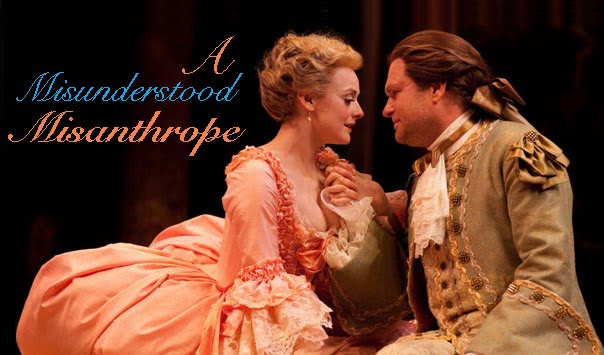
Sara Topham and Ben Carlson in The Misanthrope at Stratford.
Two or three years ago, Robert Brustein took back the notorious position he had sketched out in his 1967 call-to-arms, "No More Masterpieces," with a wimpy apology titled, aptly enough, "More Masterpieces." (For some reason, he forgot the "please.")  In it, the former artistic director of the A.R.T. - who had given the go-ahead to one desecration of the Western canon after another for something like two decades - finally whimpered that he was "ready to concede that the postmodern movement may have gone too far."

Okay - thanks for sharing, Bob!  We'll file that under "Far Too Little and Twenty Years Too Late," as we trip off to see Diane Paulus's Happy Meal re-write of Porgy and Bess at the theatre you founded!

But what recently called Brustein's pathetic essay(s) to my mind was the sad response to a genuine masterpiece that's unfolding right now at the Stratford Festival in Canada.  David Grindley's sparkling production of Molière's The Misanthrope - in Richard Wilbur's brilliant translation, of course - will be lighting up the Festival's main stage through October 29, and if you're in Toronto or Detroit, or on the East Coast, or really anywhere in the Northern Hemisphere during that time, you may want to make the journey out to Stratford to catch it.  If you love Molière, you really owe yourself the trip.

For I promise you will never see a better production; indeed, this is the best version of the great French playwright I've ever seen - even the best I've seen at Stratford, which has a long tradition of exquisite success in Molière. The idea for this mounting was originated by Brian Bedford - fresh from his triumph on Broadway with The Importance of Being Earnest - and was clearly chosen as a showcase for two of the Festival's leading actors, Ben Carlson and Sara Topham (at top), both of whom have made reputations for themselves as exponents of articulate theatre for thinking people. Bedford himself has a curiously similar rep, only with a twist.

This distinguished actor is, I'd argue, also the most versatile and successful director at Stratford (which makes him one of the best in North America); I always schedule his production on the roster of my annual visit, and frankly I've never been seriously disappointed, even though the variety of his output has been stunning (everything from Waiting for Godot to Private Lives to King Lear - yes all of them strikingly good). But Bedford's method makes him an outlier in our current theatre; over the years he has known everyone and been in everything, and so clearly bases his productions on his own well of experience from past versions he's had first-hand knowledge of; indeed, I'm not sure I've ever seen Bedford direct a script that he himself hadn't already been in, years before.

This makes him the last exemplar of an oral tradition which is dying in the theatre - he is clearly passing down how things are done to the next generation of actors, just as parents pass down their religious and cultural customs to their offspring. Indeed, when you watch a Bedford production, you sometimes wonder if you aren't also watching the ghosts of Michael Langham and Tyrone Guthrie moving across the stage behind the actors. Bedford is, in short, the personification of everything that Robert Brustein was trying to destroy with "No More Masterpieces."

Alas, due to illness Brian had to step down from The Misanthrope (he had also hoped to play Oronte - as he often manages smoothly the double trick, as in Earnest, of directing a sterling production while also shining as its star). But the ailing actor left the production in good hands - director David Grindley is also an old hand at Molière, and he has replaced Bedford with the able Peter Hutt (whom we usually see at the Shaw). The rest of the cast, which included Stratford mainstay Juan Chioran and another Shaw alumna, the great Kelli Fox (the more-talented sister of Michael J.) left one with little doubt that the production would be splendid.

Still, I was slightly surprised at just how splendid it turned out to be. John Lee Beatty's set - all chandeliers and Boucher - was ravishing, and Robin Fraser Paye's costumes would have seemed almost too scrumptious if they hadn't also been so sly - Célimène floated in a cloud of cream and cherry, below, while Alceste stewed in a vat of pale green.  For the record, the production wasn't entirely "traditional" - it was subtly updated by a century, from Molière's own era to the decades just before the "deluge" that Louis XV predicted, when rococo manners had reached their absolute zenith. Thus the usual brittle chorus of seventeenth-century harpsichords was replaced by the mournful calls of eighteenth-century viols, and a melancholic, twilit mood always seemed to be almost in the offing.


A perfect cast in perfect costumes on a perfect set . . . but sorry, the critics aren't buying!
At the center of all this corrupting luxury, Ben Carlson's unhappily honest Alceste and Sara Topham's delectably flirtatious Célimène were clearly a match for each other intellectually - and a match romantically, too, which brought to the comedy's bitter finale a surprisingly poignant tinge of tragedy; I've never felt more for these two, or for the loss of their mutual love. Perhaps this was because Carlson proved a surprisingly humane Alceste - he was more exasperated than disgusted with mankind's hypocritical follies, an approach which generally worked wonderfully, although perhaps at the finish Carlson lacked the inner, puritanical rigidity which makes sense of his final ultimatum to poor Célimène. Meanwhile Topham - who has never looked more beautiful - was far more than just a vivacious coquette; she had a taste for snark, it's true, but her Célimène was also a brilliant wit as well, and one both rebelling against the strictures of her social role while understanding that at twenty she was still allowed a little room for child's play.

These two lead performances were wonderful enough - I'd even go so far as to say that Topham's was definitive - but Grindley's work with the milieu of these two mismatched romantics was what really made the production memorable. Generally Molière's misanthrope must make his way through a gallery of simpering fops - but here, he was swimming in a tank of sharks. Kelli Fox's Arsinoé - a would-be moral puppetmaster with her claws only barely in her gloves - was truly chilling in her hauteur, and for once her conversations came off as the calculated duels they truly are. And even Peter Hutt's Oronte - often played as something close to an idiot - was here a scheming climber, with an angry taste for brutality sometimes peeking out from under his silks. Given this environment, the weary gentility of Juan Chioran's Philinte and Martha Farrell's Eliante truly charmed - although it must be said that with an exquisitely attentive irony, director Grindley allowed even his villains their own heartbreaks and disappointments.

Indeed, perhaps the intellectual balance of this production was what made it most remarkable; sometimes Molière's brilliant point-counterpoint structures seemed to almost float in space before us as the characters conversed.  I confess I've never really felt that Molière, great as he is, was quite in Shakespeare's league; but this production made me almost change my mind (at least in the case of this particular play).

But alas, few of the Canadian critics were so persuaded - because, rather obviously, they'd never gotten Brustein's second memo, and were still in thrall to the first.   Their reviews were in a way heartbreaking, however, because they could tell how wonderful a show this was, but somehow they just couldn't admit it to themselves.  The erratic Richard Ouzonian, of the Toronto Star, for instance, confessed that the acting was "flawless" and the production "beautifully designed and carefully staged." But that wasn't enough, he carped - because there was no concept:

Except for some hats and scarves that Celimene tries on at her first entrance, there are no props. None. No one sips a coffee or drinks some wine. There’s no texture, nothing to tell us more about the world these characters live in other than that they’re well-dressed, bitchy and chatty.

And finally, in a line that might have been lifted directly from Brustein:

Before our eyes, it turns into a classy evening of museum theatre, something from long ago we look at and revere, but never really understand.

Ugh. One wonders, then, why costume dramas like The Tudors flourish on cable.  Meanwhile J. Kelly Nestruck, of the Globe and Mail, likewise half-believed his own eyes, and wrote:

"David Grindley’s production of The Misanthrope dares to let an audience find the modern resonance in Molière’s masterpiece, rather than thrusting it upon them with camera-phones and references to Twitter."

But then in an abrupt reversal he added:

"It neatly illustrates both the pleasures and the perils in such a straight-forward approach, however, as its solidness is matched by a stuffiness – and actors stuck in gorgeous, but stifling costumes that seem to wear them rather than vice versa."

Sigh.  Almost schizophrenic, no? Yet those were both typical of the press's scarily anhedonic reactions: "This is a marvelous production," the critics agreed, "only it's not, really, because it's traditionally costumed." It's enough to make you wonder at the superficiality of these people, and perhaps muse at the lock-step orthodoxy of the supposedly "revolutionary."

So please, somebody send around Brustein's latest to the Canadian papers! Then maybe theatres can continue to keep what's best about our theatre alive - until that happy day when Brustein himself is long forgotten, and we'll once again be allowed to have more masterpieces.

Thursday, September 2, 2010

Shakespeare at Stratford

For the American theatre-lover, the Stratford Festival right now feels like some sort of theatrical Promised Land, just across Lake Erie, where huge casts (with live music!) perform complicated, challenging versions of the canon almost entirely free of the various strains of cant emanating from New York, Chicago, and the academy. None of the three Shakespeare productions I saw - As You Like It, The Tempest(at left), and The Winter's Tale - were among the very best I've seen the Festival do (all the greatest Shakespeare I've ever seen has been either in Britain or Canada). But all three kept me engaged with their ideas, emotion, and, to be honest, old-fashioned staging prowess - and I left seeing at least one of the plays (As You Like It) in a new light. I'm not sure how America lost its way, but after this and my recent trip to London, I'm beginning to wonder why, exactly, Americans have such a problem producing classical theatre.

Part of that problem, of course, is that in the States we think of classical theatre as "a problem." How are we going to save it? is the constant cry, which of course inevitably leads to surgical solutions which flirt with killing the patient.

Compare to Stratford, where over and over again, I was struck by how the actors - speaking lines that are literally four hundred years old - easily connected with the audience as if it were the most natural thing in the world. As if that connection were a simple thing - obvious, even.

I suppose the reasons for this miracle are myriad. In Canada, the connection between acting for the stage and acting for the screen was never severed, as it was here. The Canadian educational culture likewise hangs onto the rudder of tradition - kids still learn Shakespeare in Canada; I'll never forget watching The Taming of the Shrew with 1500 high schoolers in the Festival Theatre and realizing they were catching every joke, following every line.

And somehow Canadians aren't paralyzed the way Americans are in the cross-hairs of puritanism and prurience, and thus are more easy-going about the body (and their own humanity); in the Stratford A Funny Thing Happened on the Way to the Forum, for example, the Roman statues sported hilariously huge schlongs, and I remember in a Molière production a decade ago, a woman nonchalantly breast-fed her baby in the background; bare bums, bare boobs, and full frontal have crossed Stratford stages, and in an earlier Tempest, Caliban even completed his self-humiliation (on the line "Come, kiss!") by burying his face in Stephano's butt. (The audience just went "Ewwww!" and the show went on.) Even this year, Touchstone groped Audrey (to her bemusement) in As You Like It, and various nookies were tickled in Dangerous Liaisons without anyone batting an eye; the evil Diane Paulus would have no sway over these people.

Of course a deeper factor at work is simple experience; Christopher Plummer, who essayed Prospero this season, tore through several Shakespearean leads at Stratford in the 60's. Ben Carlson, this year's Leontes, has already done Brutus and Hamlet; when Lucy Peacock galumphed onstage as Audrey, I suddenly realized I'd first seen her at Stratford in 1988, as Helena (she's been there most years since). Other veterans abounded, including Tony-winner Brent Carver (one of the few actors ever to triumph as Hamlet, Tevye, and the Pirate King), Martha Henry, the great Seana McKenna, Tom McCamus, John Vickery, and Geraint Wyn Davies, while a "new" (or at least "newish") generation - including Dion Johnstone, Sarah Topham, Yanna McIntosh, and Bruce Dow - began to take pride of place in leading (or larger) roles. That's another joy of attending Stratford, btw - unlike in the tiny, faux "repertory" company at the A.R.T., you can actually see actors arrive, mature, achieve greatness, and move on at Statford.


Ben Carlson sees the errors of his ways too late in The Winter's Tale.

But back to the productions themselves. All successfully integrated what you might call "mass appeal" with sophisticated insights. Marti Maraden's Winter's Tale was the most traditional of the three. Maraden didn't try to "solve" the play's central problem - how to explain the sudden, psychotic jealousy of its protagonist, Leontes - but instead focused on subtly tying together the tragic and comic touches of this famously experimental play into a tone that pretty much worked throughout (believe it or not). She was helped by strong performances from Yanna McIntosh as the victimized Hermione, Seana McKenna (of course) as a subtly funny Paulina, and a consummately wry turn from Tom Rooney as the thieving Autolycus. I didn't quite buy lead Ben Carlson (above) as the haunted, vulpine Leontes of the first half - but his repentance in the second half proved quite moving; this was one Winter's Tale in which the restoration of the hero's happiness felt truly earned.


Brent Carver as Jacques pops right out of As You Like It.

Des McAnuff's almost-overstuffed production of As You Like It, by way of contrast, took a strikingly new perspective on its text: McAnuff seemed to approach the play not as a roundelay of romantic engagements but rather as a study in disengagement. Indeed, the avatar of the production was not Rosalind at all, but rather Brent Carver's Jacques, who at one point popped right out of the set design (above) as if to impress on us his importance. And Carver was an unusual Jacques, to boot - hardly dyspeptic or even particularly depressed, he was instead an utterly disinterested intellectual, as well as a dead ringer for René Magritte's famous Son of Man (at left - that apple made an appearance in the production, too).

At first I resisted this conceptual gambit, I admit - Magritte's imagery makes for rather a chill Forest of Arden - but it grew on me as the play progressed; for Magritte, that great questioner of all appearances (including, of course, the appearance of love) is not so far in spirit from the questioning spirit animating almost everyone in the play at some point. If McAnuff had managed to somehow conjure a real tension between his vision for Jacques and Shakespeare's vision of Rosalind, he might have come up with an As You Like It for the history books. But alas, he had a bright, clever, but somewhat mechanical Rosalind in Andrea Runge, and if no one in Arden is believably in love, there's not much to really question, is there. Still, there was good character work around the edges of the show, not just from Carver but also from Lucy Peacock (a definitive Audrey, frankly), Cara Ricketts (a mischievous Celia) and Randy Hughson (a delightfully droll Corin). And the design team had clearly gone into overdrive on this one, producing one striking image after another (below).


A cold, but beautiful, Forest of Arden in As You Like It.

Finally, there was the production that probably was responsible for bringing the crowds back to Stratford this year (the weekend I attended, virtually everything was sold out): The Tempest, starring the eighty-year-old Christopher Plummer as Prospero. And I'm here to report that, yes, Mr. Plummer is still a consummate stage magician, although on the night I attended he was clearly husbanding his energies for his big moments (which including a memorable "Ye elves of hills" and a quietly heartbreaking "Please you, draw near"). Elsewhere, a deft touch was consistently in evidence - his was a crustily witty Prospero, and one designed to make light of the role's latterday revision into colonial oppressor, even though director McAnuff seemed most interested in the political aspects of the play (his Miranda, Trish Lindstrom, was a kind of sturdy, knockabout utopian).

This dodging of political correctness was all the more unusual in that McAnuff had cast an African-American, Dion Johnstone (one of a rising number of actors of color at Stratford these days) as Caliban (right), and an Asian woman, Julyana Soelyistyo, as Ariel (at top). These choices didn't seem to translate into an aesthetic of identity politics, however - as they would almost inevitably in America. Instead, Johnstone's Caliban was depicted not as sentimental colonial victim but as something close to Shakespeare's terrible vision - a flawed creature both power-hungry and yet eager to serve somebody as slave. (Today we often forget that Caliban has no vision of "freedom," as Ariel does; he simply wants to trade Prospero for Stephano.) Johnstone was close to an ideal Caliban, I thought, and while Soelyisto was hardly a musical Ariel, she was a dazzling acrobatic one; her opening gambit - "swimming" some thirty feet straight down from the top of the Festival Theatre to the stage, to retrieve Prospero's magic book from the ocean floor - was one stage image I will always remember.

Other moments of literal magic dotted the show (although the design was otherwise almost too restrained), but there were gaps in the acting among the courtiers that held the production back from greatness. And while Bruce Dow made a rather originally simpering - and obviously gay - Trinculo, Geraint Wyn Davies offered only a solid, rather than an inspired, Stephano (he didn't seem quite sure how to play off Dow, who therefore simply chewed the scenery, albeit with consummate skill). Still, this was a Tempest of uncommon clarity and depth - in which McAnuff delineated cleanly and beautifully the recurrent motif of power struggle that serves as the spine of this exquisitely meditative play. I'm not sure when I'll see its like again.

Monday, August 23, 2010

A year to remember at Stratford


I'm back from the Stratford Shakespeare Festival in Stratford, Ontario, which is enjoying its strongest season in years. The six productions I caught were all good to very good, although it was Jacques Brel is Alive and Well and Living in Paris (above), and a splendidly-produced Peter Pan that brushed greatness rather than the widely-touted Christopher Plummer Tempest (its most stunning image - Ariel retrieving Prospero's book from the depths of the sea - at left). What was clear from the eight productions my party saw was that new artistic director Des McAnuff was, indeed, the right choice to head the festival; to be honest, I can't remember Stratford ever being quite this consistent (but then we missed its apparent high point - a new play by Michel Tremblay - as well as its two bombs, King of Thieves and Two Gentlemen of Verona). Even the productions which I disagreed with (like McAnuff's As You Like It, at top) left me thinking seriously about their texts; more to follow later this week.

Thursday, September 10, 2009

Is Stratford better than New York?, Part II


Geraint Wyn Davies waves to the mob in Julius Caesar.

In this part of my annual Stratford Festival recap, I'll be looking at the productions that proved problematic or even outright unpleasant. But first I have to put forth the proviso that "problematic" doesn't always mean "less satisfying" - indeed, the first production on my list, James MacDonald's Julius Caesar, was easily the best production of this tragedy I've ever seen. To be honest, I've only seen three (plus the two film versions), but this only points up how rarely the show is done, considering its fame (I've seen just about every production I had a chance to). This is partly due no doubt to the drama's casting requirements (you need a large bevy of solid middle-aged male players, and at least three stars) - but also partly to its misshapen structure.

I call it "misshapen" because the play's obvious climax - the assassination of Caesar - occurs halfway through, at which point what was already an unusual form of tragedy (in which one sympathetic hero plots to kill another) shifts gears awkwardly into new psychological, political and aesthetic territory that remains vague in its form (and limits) until the very finish. We realize we're supposed to shift our allegiance to a new "tragic hero" (who has just killed the title character), and question the seeming motivations of nearly everyone we've met so far. But during this intriguing process the play all but abandons the clear elucidation of the history at hand, and at any rate its psychological and moral investigations come to an inconclusive pass; the ending of Caesar is multivalently ironic, and whether Shakespeare himself saw Brutus's end as tragic will, I think, always be debated.

I've yet to see a production (or movie!) make it through these straits unscathed, and the Stratford version was no exception; although it seemed clear that the director and actors understood the aesthetic questions at hand, even if they couldn't quite answer them. Perhaps it was this meta-awareness that made the production compelling despite its flaws. Or perhaps it was the fact that, to put it simply, when the play was coherent - and of course through its entire first half it's brilliant - so was James MacDonald's robust direction. Much in the first half thrilled; Macdonald's management of the Roman crowd was superb, and his delineation of the relationship between Cassius and Brutus was subtle and insightful. The dueling funeral orations (and their consequences), were rousingly staged, with the mob surging up and down the theatre's aisles, and even the near-hallucinatory sense of Rome tipping toward chaos was powerfully evoked.

Still, the remainder of the play disappointed, because while MacDonald proved a great stage conductor, he hadn't drawn compelling personal performances from his Brutus (Ben Carlson), Cassius (Tom Rooney), or Antony (Jonathan Goad), and the only way the fractured second half can grip us is through the power of these distinct personalities (ironically, the first half of the play can work via the interlocking plots of their public personae; but once the war begins, the script depends on their private dramas). Ben Carlson made an appropriately intellectual, but somehow rather too placid, Brutus, and Jonathan Goad, when not being manipulated by MacDonald, didn't seem to understand how he might connect the contradictory sides of Mark Antony. Meanwhile Tom Rooney provided a capable, but rather low-key Cassius. Still, the able Geraint Wyn Davies (at left) made just about the perfect Caesar, and there was admirable support in a number of minor roles (although not from the women, who seemed to have wandered in from another play).

There are several other plays to cover, btw, so my apologies for running on about Caesar. But I do have to add the one thought that kept surfacing during my experience of the production: "Why can't Boston have something like this?" Not even a great production of Julius Caesar, but merely an intelligent, interesting one? Why can't Harvard or BU see their way clear to funding that?

Well, we'll have to ponder that at some later date; for at the moment there are still three more Stratford productions to consider. And perhaps the most frustrating of these three was Martha Henry's production of Three Sisters, which to my mind seemed almost like a mirror image of Julius Caesar in its issues and effect. Henry, a highly lauded actress herself, drew superb performances from three of her actors - Lucy Peacock (Masha, at right in photo at left), Tom McCamus (Vershinin), and James Blendick (Chebutykin), and at least intermittently compelling ones from two more, Juan Chioran (Solyony) and Kelli Fox (Natasha). Henry even offered a few compelling new insights into the text (she hinted, for instance, that Natasha was pregnant before her marriage to Andrei - although perhaps not with his child). But in a play that, like all Chekhov, depends upon its ensemble, several key performances (including two of the three sisters) were weak - and Henry didn't seem to know how to compensate for this technically. Particularly in the final act, she left her actors flailing, whereas a director/conductor like MacDonald would have attended to pacing and orchestrated something more cohesive. The results were therefore on the one hand, occasionally shattering (particularly when Peacock and McCamus were onstage), but on the other hand, exasperatingly tedious. And as everyone knows, the trick to Chekhov is to not allow the tedium that the characters all complain of to extend to the audience, too.


An unusually passionate moment from Phèdre.

Particularly when tedium ruled another Stratford outing, a rare production of Racine's Phèdre (from a slightly mannered new translation by Timberlake Wertenbaker - remember her?). The National Theatre's recent broadcast of Ted Hughes's freer, more dynamic translation (yes, two major Phèdres in a single year) gave a pretty good idea of how the play can succeed - via coiled, destructive passion - but director Carey Perloff took a very different route, to pretty disastrous results. Indeed, Perloff's direction felt almost like a textual thesis inappropriately deployed as a theatrical approach - sensing the strict discipline of Racine's verse, and the Catholic aura of sexual suppression in his moralism, Perloff ran with those as the core of her interpretation, rather than sensing actual drama would require some sort of conflict with those precepts. Thus the usually phenomenal Seana McKenna was stuck working in a kind of straitjacket, and of the supporting cast, only Tom McCamus brought much interest to his Theseus (and then only in a worldly way that made little sense of his impulsive actions). The seventeenth-century-inspired fashions were lovely, and occasionally the production did achieve a tone of something like muted transcendence, but that was hardly enough to carry it through even its relatively-brief 100-minute running time. During the performance I attended, a patron actually fell asleep and rolled off her chair like a log. Luckily, she wasn't hurt by a response that, as criticism, couldn't have been more pointed.

My final production at Stratford was a studio version of George F. Walker's Zastrozzi (Rick Roberts, at right, as the title character), a play which at the time of its writing (the 70's) was quite popular up north, but never achieved much of a profile in the U.S. (Walker has become better-known since, although this is the first piece by him I've seen). The script was graced by a truly brilliant production, directed by the up-and-coming Jennifer Tarver and featuring a dazzling cast led by Sarah Orenstein (late of the Shaw), Oliver Becker, Andrew Shaver and John Vickery. But alas, as one reviewer put it, this only made it obvious that the flaws in the show were indeed built right into the script.

Said script is certainly an odd duck, and one that perhaps too often flies in circles, but which sometimes takes wing with a surreal resonance. Zastrozzi, an evil genius and self-proclaimed "master criminal of Europe," is bent on killing Verezzi, a self-proclaimed artistic visionary whose visions are, for the most part, psycho-art-babble. Zastrozzi's motive is simply the mediocrity of Verezzi's art - he's killed off plenty of second-rate artists before; indeed, he argues that he can't wait for God to administer artistic justice, because he's an atheist.

But there are other, deeper psychological issues moving beneath Zastrozzi's M.O., including the murder of his mother - and he soon finds himself mixing it up with a whip-wielding dominatrix (Orenstein), a priest searching for salvation (Vickery), a hatchet man with an axe to grind (Becker) and a virgin who's always in the wrong place at the wrong time (Amanda Lisman), all of whom seem to be floating in a non-determinate space which director Tarver suggests might be an insane asylum. Walker's method throughout is to spike twisty metaphysical argument with sitcom-level one-liners, an amusing enough mix, to be sure - but we find ourselves wishing he'd stick with one line of argument for longer than he seems able or willing to do. The results are therefore more superficial than the playwright intends, or pretends; still, the play remains intriguing enough that I hope to see more Walker in these parts sometime soon.

Tuesday, September 8, 2009

Is Stratford better than Broadway?, Part I


Brian Bedford as Lady Bracknell.

My recent trip to the Stratford Festival confirmed what I'd already heard via the Web - new Artistic Director Des McAnuff had consolidated, and perhaps extended, the artistic achievements of his inaugural year (which had been been marked by the collapse of a short-lived artistic "triumvirate"). What I saw on Stratford's stages last summer led me to opine that of those three contenders, McAnuff seemed the best man for the top job - so I was happy to take this season as confirmation of that hunch. What's striking about the Festival now is its consistency - under the previous artistic director, Richard Monette, the company hit one or two out of the park, reliably, every year, but each season dropped a few bombs, too. But this time, as last, even the weakest production I saw (Phèdre) was intelligently, if misguidedly, produced, and the acting company struck me as stronger across the board than ever before (perhaps because McAnuff has skimmed some of the cream from the nearby Shaw Festival).

Of course perhaps I just missed the bombs this year (word was not good, I admit, on Macbeth), but the season boasted at least three proper smashes - Brian Bedford's The Importance of Being Earnest, Colm Feore's Cyrano de Bergerac, and an electrifying revival of West Side Story, all of which I caught; meanwhile friends who opted for A Funny Thing Happened on the Way to the Forum over Cyrano (they were in the same time slot our weekend) proclaimed it a witty hoot (despite having lost its original lead, Stratford stalwart Bruce Dow). I also enjoyed an ambitious production of the more-rarely-done-than-you'd-think Julius Caesar, which proved flawed, but still worthy, as well as a lavish, inventive production of Ben Jonson's Bartholomew Fair that almost succeeded in putting the play's obscurities over. More mottled, but still intriguing, were a new production of Three Sisters (directed by Martha Henry) and a revival of Zastrozzi, an early work by Canadian playwright George F. Walker.


First, the hits. Brian Bedford's production of The Importance of Being Earnest (above), felt at times almost textually definitive, although its pace was perhaps too leisurely (and its Algernon was only adequate). Bedford not only directed but took the role of the imperious Lady Bracknell - he approached the part utterly seriously, however; his Bracknell was no dragon lady in drag, but instead proved a closely observed, delicately scaled skewering of Tory insanity. The rest of the cast was nearly as good, led by Ben Carlson's tormented Earnest/Jack and Sara Topham's breathlessly blank Gwendolen, who were themselves sometimes outshone by supporting players Sarah Dodd and Stephen Ouimette, who made the best Miss Prism and Reverend Chasuble I've ever seen. But what was striking was Bedford's consummate comprehension of every subtlety in the play - as evidenced by the superb set from Desmond Heeley, which neatly tied together a kind of Gorey-esque, end-of-empire morbidity with a strange sense of false spring. Bedford is of course widely known as one of our leading stage actors, but I don't think his accomplishments as a director have been lauded nearly enough. Over the years, Bedford has directed the best Lear and Othello I've been lucky enough to see, as well as the best Waiting for Godot, believe it or not, along with sterling versions of Coward's Private Lives and Present Laughter. So I'll say it out loud, just so someone somewhere has said it once: Brian Bedford is among the best directors working in America.

Another production which had a claim to the title "definitive" was Cyrano de Bergerac, featuring Colm Feore, a former Stratford leading man who left to make a name for himself in Hollywood. Feore didn't quite attain stardom, but did appear in several blockbusters, before notoriously stealing a New York production of Julius Caesar right out from under its under-trained American stars. At any rate, he has now returned (along with other Stratford stars like Geraint Wyn Davies and Christopher Plummer, who'll be back next summer for The Tempest), with the clout to pick his own projects, and he's chosen the perfect vehicle to showcase his strengths in Cyrano. Feore was never the most interior of actors, but his physical gifts are superb (and he needed them all in this three-hours-plus lead performance) - and he's been technically trained to a level that's almost unheard-of today. All this, plus the crafty intelligence of a born actor, and the thoughtful direction of Donna Feore (his wife!) led to a Cyrano that never devolved into grandstanding or ham, but grew steadily in emotional stature over the course of the play; by its finish, this cynical old critic was misty-eyed, and many in the house were weeping.


Colm Feore as Cyrano, with Tom Shara as Christian.

The rest of the Cyrano cast was solid, but only occasionally sparkling (although the reliable John Vickery was a standout), but Feore was matched by a truly smashing physical production, which came complete with pyrotechnics, convincing swordplay, full moons of course, and even autumn leaves drifting down into the crowd. It was the kind of old-fashioned, satisfying spectacle that lets its audience out into the night in a happy buzz of romantic amazement - and utterly eclipsed the last Cyrano I saw, with Derek Jacobi in New York.


The dance at the gym from West Side Story.

But then "better than New York" was what you also heard about another show, Gary Griffin's restaging of West Side Story. (The same comparison was whispered a few years ago about Stratford's South Pacific, too, but this time the murmur has grown to a chorus.) To be honest, Griffin, of the Chicago Shakespeare Theatre, has embellished West Side with a few unwanted accoutrements: having a young, modern-day boy wander through the proceedings to warble "Somewhere" like some second coming of the promised Obama-child, for instance, was a little dumb, and a little much. But generally Griffin colored energetically within the spectacular lines of the great original, and choreographer Sergio Trujillo expertly retooled Jerome Robbins's famous choreography for the Festival's thrust stage. And the cast all but tore through the material, dancing and singing its heart out, led by Paul Nolan's amazingly athletic Tony (his hand-over-hand up Maria's balcony was a hoot), Chilina Kennedy's refreshingly earthy, at times even knockabout, Maria, and Jennifer Rias's happily snappy Anita. West Side Story is rarely revived because of its intense demands - Bernstein at times pulls his vocal lines up into operatic territory, while Robbins pushes the dancing past the brink of ballet - and yet the pay-off when a production is firing on all cylinders is intense, and immense; it is probably the single most exciting musical ever written, and Stratford more than delivered its inherent thrill.


The climax of Bartholomew Fair.

Meanwhile, on its smaller Tom Patterson Stage, the Festival was mounting a piece nearly as challenging: what may be the North American premiere of Ben Jonson's Bartholomew Fair, a sprawling Jacobean hootenanny that cynically casts a large cast of Puritans into the labyrinth of the eponymous fair, a notoriously debauched public spectacle in Jonson's day. Unsurprisingly for this particular playwright, everyone pursues their particular "humour" (or obsession), which results in adventures that reveal (or confirm, in the case of the earthier types) their true natures (Justice Overdo, played by Tom McCamus, at left, receives a particularly brutal comeuppance).

What's unusual for Jonson, however, is how in the end he forgives his many hypocrites and fools; Bartholomew Fair may be cruel, but the playwright skips his usual final damnations for a surprisingly touching moment of (unlikely) community, that reads as his own sleazebag version of a Shakespearean comic climax: the humiliated Justice Overdo, at last converted to an appreciation that he is, in the end, mere "flesh and blood," invites the bawds, pimps and whores to dinner at his home (!), an invitation which is enthusiastically accepted.

This proved a hearty dénouement to what was admittedly a brilliant production, the best version of any Jonson play I've seen. Director Antoni Cimolino (who also administers the Festival) poured resources into the project, and cast many of the company's leading actors in key roles (backed by up-and-coming youngsters from the Birmingham Conservatory). The results were studded with brilliant performances (from Lucy Peacock, Juan Chioran, Cliff Saunders, Kelli Fox), and Cimolino's stagings and musical interludes were clever, apt, and fearless (I won't soon forget Peacock, locked in a grotesque fat suit, spreading her legs and fanning her privates - likewise the jar of communal urine that gets tossed about onstage is seared into my memory).

Still, despite just about the best production it could ever hope to receive, the play eventually seemed to be grinding on, as in my opinion Jonson always does. The trouble is that he's such a schoolmarm - a dirty-minded schoolmarm, true, but a schoolmarm nonetheless, and one locked in a "humour" as intense as that of any of his characters. And despite the final pseudo-Shakespearean flourish, the play is nothing like those of the Bard, who is continually opening up new perspectives on his characters and even his plots - while Jonson relentlessly drives home, through a zillion variations, a single anti-moral we long ago figured out for ourselves (it's telling that he wraps the proceedings with a caustic puppet-show; that's what he's been writing all along). So while I had to admire this virtuosic production, I have to admit I was happy when Bartholomew Fair finally folded for the night.

Tomorrow: the more problematic Stratford productions.

Wednesday, August 26, 2009

More festivity

Today I'm off to my final summer theatre festival - the one I've been going to for something like 25 years, Canada's Stratford Shakespeare Festival. The eight plays on tap for the weekend are: The Importance of Being Earnest, A Midsummer Night's Dream (at left, with Yanna McIntosh and Geraint Wyn Davies) Julius Caesar, Bartholomew Fair (Jonson), A Funny Thing Happened on the Way to the Forum, Three Sisters, Phèdre, and a new play, Zastrossi (George F. Walker). This means that, after the Williamstown Theatre Festival and the Edinburgh Fringe, I've actually seen more plays this month than there were days in the month - 32 different productions, in fact. (Take that, Larry Stark!) Not that I wouldn't be happy to do it again next month (indeed, I'm planning a Chicago theatre outing for the fall). In the meantime, stay tuned for the Canada recap.

Tuesday, September 9, 2008

What I saw at Stratford

Okay, Labor Day has come and gone, I'm back from Fire Island (!), and it's time to put the nose to the old reviewing grindstone. First, there's some catch-up to do. I spent a long weekend at the Stratford Festival in August, attending seven plays in a row (that's actually not my personal record), and I've been meaning for weeks to put in a word about them.

This was an administratively unsteady year at the Festival - the first since the departure of longtime Artistic Director Richard Monette, whose tenure was marked by financial stability but artistic variability (for a sense of the pressures facing the Festival during the Monette years, check out the hilarious Canadian series Slings and Arrows). Without a clear heir apparent, the Festival attempted to divide the artistic directorship into a triumvirate, which promptly fell apart, with the usual finger-pointing, leaving one member, Des McAnuff, late of the La Jolla Playhouse and Broadway, basically in charge. But artistic chaos did not ensue; instead, there was a palpable "rallying 'round" this particular fabulous invalid - old stars returned, new ones were minted, and there was a sense of greater general commitment to artistic seriousness. True, rising gas prices (and the unwise decision to do only Shakespeare in the largest theatre) conspired against the box office, but this was still clearly the strongest Festival season in years.

Artistic Director McAnuff helmed the season's barnburner, Shaw's Caesar and Cleopatra, starring Stratford vet Christopher Plummer (at left, with Nikki M. James as Cleopatra). The production garnered raves, perhaps largely for the way McAnuff cleverly deployed a beautifully abstracted set (above right) in the giant Festival Theatre. Many were also thrilled to find that at 78, Plummer can still buckle some serious swash (a few readers may recall his magnetic movie debut in The Fall of the Roman Empire); his voice was in fine form, his timing (as always) was exquisite, and although he dodged one bit of derring-do (a leap from the top of the lighthouse at Alexandria!) he was confidently and charismatically physical throughout. But oddly he didn't utilize his age (he's a generation older than Caesar was when he met Cleopatra) to plumb any particular depths in the role (the central relationship of this early Shaw - which is hardly historically accurate - foreshadows the great romantic encounters between youth and age in Pygmalion, Heartbreak House, and other works). Meanwhile director McAnuff seemed happy to play many of Cleopatra's intrigues for easy laughs (even the murder of the slave Ftatateeta - here hammily embodied by Boston favorite Diane D'Aquila - didn't inspire him to sound any solemn notes). Still, McAnuff struck me as basically the right man for the job at Stratford - C & C was suffused with a warm brio and clever theatrical intelligence, and friends who caught his Romeo and Juliet (which I missed) found it one of the best they'd seen.

Still, there were deeper pleasures to be found elsewhere. Probably the best of the Festival was Love's Labour's Lost, directed by the great Michael Langham (whose all-but-definitive production at Stratford in the 80's remains one of the highlights of my playgoing life). Langham was sidelined by an injury during rehearsal, and Richard Monette stepped out of retirement to sub for him - but the production was clearly Langham's, and beautifully limned the veins of melancholia running through this arcanely witty bagatelle. Alas, the production boasted a solid, but not commanding, Berowne, and an even weaker Rosaline. But there was brilliant work all around this central pair: Peter Donaldson's Don Armado (above left, with 11-year-old Abigail Winter-Culliford as Moth), Alana Hawley's Princess of France, and Brian Tree's Costard were all superb, and John Vickery's Holofernes and Gareth Potter's Nathaniel were actually startling, they were so exquisitely funny (with material that has stumped many an actor before them). What always impresses me about LLL is that in it, Shakespeare first reveals himself as a brilliant critic of his own material (perhaps the most brilliant that ever lived, or will ever live); the final autumnal sequences operate as both a deconstruction and extrapolation of all that has come before - and Langham once again conducted this thematic symphony (he's done six productions of LLL) with amazing subtlety.


There was still more good news. Fuente Ovejuna, by Lope de Vega, is rarely seen, I suppose because of its casting requirements - there are about twenty featured roles, with plenty of village folk, knights, and courtiers milling about, too (see above); but it's such a crowd-pleasing potboiler that I wonder more productions aren't mounted anyway. Stratford did well by the play, in its first stab at classic Spanish drama (they brought in a specialist, Laurence Boswell, to direct), and the crowd clearly loved it. I felt the production occasionally tilted too far into melodrama (as the villainous Guzman, Festival veteran Scott Wentworth all but twirled his mustache), but was more often refreshingly direct and robust, with affecting turns from Jonathan Goad and especially Sara Topham (below right) as the young lovers at the center of the plot. Charles Isherwood of the Times complained of the lack of Shakespearean brocade in de Vega's voice, and he's quite right - textually, Fuente Ovejuna seems almost too simple and straightforward. But thematically and politically, it represents a startling leap, one that Shakespeare, for all his universality, never made. The drama follows the eventual uprising of Fuente Ovejuna (note the play is named after a village) against its cruel overlord, and makes explicit a dynamic of solidarity that wouldn't find expression again until Brecht, over three centuries later (although de Vega is inherently optimistic, while Brecht is anything but). De Vega's vision of sexual equality is even more startling; true, his play does obeisance to the standard tropes of virginity and purity, but its women are hardly obedient, and its central married couples behave with an affectionate harmony unknown in Shakespeare - in keeping with the embedded theme that love itself can be the most powerful political principle. It's an obvious future choice for the Huntington (although one prays the ART never goes near it) - and a double production, in both Spanish and English, a la the Apollinaire Theatre's open-air productions in Chelsea, would simply be the icing on the cake.

The Festival wasn't solid gold (it never is), and this time both Hamlet and All's Well That Ends Well proved disappointing - Hamlet particularly so in that it starred Ben Carlson, an actor who's done sterling work at the Shaw Festival and in Chicago. As the great Dane, however, Carlson was always emotionally charged, but grew monotonously childish as the evening wore on, and he didn't even attempt the mature equipoise that should mark the final act. And around Carlson the acting was highly variable - Gertrude and Horatio were outright bad, and Claudius sometimes inaudible; only Geraint Wyn Davies, as an affectionate, if addled, Polonius, was memorable. Big-name director Noble, for his part, seemed too distracted by his intriguing meta-theatrical design to actually pull the production together. All's Well, alas, was even more of a drag, although director Marti Maraden's work did sparkle with some brilliant literary insights - indeed, All's Well aficionados might want to catch the production simply to see how Maraden makes Lavatch, Shakespeare's least funny clown, work thematically as the center of the piece.

Well, so much for them. The last two productions I caught were both grim and gripping. Stratford did a truly astonishing Medea a few years back, with the great Seana McKenna in the title role, and I had hopes that the Festival's The Trojan Women (again with McKenna) might prove as riveting. That, alas, was not to be (the play is hardly Medea, after all) but the production was always compelling, and sometimes truly harrowing. As Andromache, McKenna entered (at left) with memorable gravitas, and endured the murder of her son with expert understatement; meanwhile, as Cassandra, Kelli Fox (sister to Michael J. Fox) took exactly the opposite tack, to nearly as absorbing effect. But young Yanna McIntosh stole the show from both of them as a coiled, vulpine Helen, who cleverly argues her way from execution back into her husband's bed.

My final stop was the double bill of Eugene O'Neill's Hughie and Beckett's Krapp's Last Tape (one of the few theatrical evenings that could be considered more depressing than The Trojan Women), both essayed by the redoubtable Brian Dennehy. The juxtaposition of the plays was somewhat illuminating (both deal with issues of personal illusion), but clearly the main event here was Dennehy's performance(s). In Hughie, a vignette about a high-rolling blowhard who lost his will to live with the death of his favorite audience, the eponymous night clerk Hughie, Dennehy essentially offered a variant on his usual hearty, overbearing self. Still, he did accurately delineate the arc of the character's decline as he desperately sought something of the same solace from Hughie's replacement, Joe Grifasi (who actually upstaged Mr. Dennehy with a consummate minimalism), and even hinted at a weird sense of vampirism in the seemingly upbeat ending.

It was as Krapp (at right), however, that Dennehy triumphed. His physical transformation was complete - the character's decrepitude was worked out in every detail. Beyond that, however, the actor put an unusually horrifying spiritual stamp on the role: this Krapp wasn't just despairing, he was damned (indeed, a faint gasp rose from the audience on his first appearance, in which Dennehy deployed a truly disturbing 1000-yard stare). To my mind, the play's famous opening shenanigans with the banana peels were here overdone (this nod to Buster Keaton should, I think, operate as a mere preamble), but once Krapp settled into listening to his younger self on tape, the production turned suddenly harrowing. It was interesting, in fact, to compare Dennehy with Alvin Epstein, who has a kind of lock on local Beckett performance. Where Epstein is elfin and ethereal, Dennehy was utterly physical; in this Krapp, we weren't lost in existential memory - this was simply a guy with a tape recorder, and that was it: only the results were somehow more crushing and less academically mournful than Epstein usually is. I couldn't help but wonder if Dennehy - who played at the Calderwood not so long ago - could be tempted to bring this double bill to Boston. It might give the locals a sense of the kind of challenging intellectual theatre we still don't get enough of.

Monday, August 20, 2007

Stratford Festival Round-Up

Sorry for the gap in blogging, but I've just returned from my annual pilgrimage to the Stratford Festival in Ontario. At left is Brian Bedford, in the title role of King Lear - which, incredibly, he also directed. Reviews were mixed - the gist was that Bedford had delivered a star turn, but had neglected to shape a full production - but by the time I saw it, through the alchemy of repeat performance, somehow the precisely opposite effect had been achieved: now the production as a whole was stronger than Bedford was, and easily eclipsed the Christopher Plummer/Jonathan Miller staging which Stratford mounted some five years ago and toured to New York.

Bedford has given us a traditional (if somewhat creatively edited) and strikingly straightforward Lear - and the results are always gripping, and at times staggering. In fact, this is the best Lear I've ever seen (although that call may change after I catch Sir Ian at BAM later this year, in a production which crosses the pond to very positive buzz). Bedford's own performance is not perfect; he doesn't quite bring off the shattering finale - and even, unforgivably to some, leaves Cordelia's corpse to expire by himself, in a spotlight, of course. But this is the only slice of ham served by an actor who's been prone to far more generous helpings. For the remaining three hours, Bedford remains utterly disciplined, etching a portrait of a petulant, increasingly decrepit patriarch who realizes rather earlier than the average Lear, and with lacerating self-awareness, the depth and breadth of his folly.

But the production is never merely a setting for a star turn, whatever the local critics said. Bedford has surrounded himself with talent, and there are penetrating, spirited interpretations from Dion Johnstone (Edmund), Wayne Best (Cornwall), Wenna Shaw (Goneril), Wendy Robie (Regan), Scott Wentworth (Gloucester) and Gareth Potter (Edgar). I found myself particularly moved by Wentworth and Potter - in this Lear, more tears were shed during their encounters on the blasted heath than were spent at the finale. One last mention - at the performance I attended, Keith Dinicol had to step in for Bernard Hopkins as the Fool, and acquitted himself admirably.

I'd urge any Bardolator like myself to make the trek to catch this version - but of course it's a long way to go for a single show; what else should you see at the Festival if you do decide to book that flight? What my friends and I found worthiest were Richard Monette's intelligent (if, again, traditional) An Ideal Husband, by Oscar Wilde (at left), and a worthy attempt to put over Albee's A Delicate Balance (featuring a Tony-worthy performance from Fiona Reid), which rewardingly scaled the first two acts, but lost ground in the inferior third. Elsewhere, Richard Rose directed a Merchant of Venice that was studded with intriguing ideas, but hobbled by a listless Antonio and a lackluster Shylock (and some of the worst costume designs to ever traverse the Stratford stage). Of the musicals, we found My One and Only far superior to Oklahoma, and can recommend the reliable Seana McKenna's solo rumination on Anne Hathaway, Shakespeare's Will. Shows not seen by my merry band, but enjoying a positive (i.e., often sold-out) response, include To Kill a Mockingbird, The Blonde, the Brunette, and the Vengeful Redhead and Of Mice and Men - but we feel compelled to dissuade all comers from either The Comedy of Errors or Othello. Now get thee to Canada - if only for a sample of what a real theatrical culture feels like.

Friday, June 29, 2007

William Hutt, 1920-2007

Word reaches us that William Hutt, a mainstay at Canada's Stratford Festival, died on Wednesday. Little known to Boston audiences, Hutt was a legend in the Canadian theatre, playing at Stratford (which I regularly attend) for a staggering 39 seasons and 130 productions, essaying virtually every major role in the repertory. His most famous performances included Prospero, King Lear (he also played a memorable Fool to Peter Ustinov's Lear), and Falstaff; he was also remembered for a hilarious turn in drag as Lady Bracknell in Wilde's The Importance of Being Earnest. Perhaps his best recent performance was as James Tyrone in O'Neill's Long Day's Journey Into Night, opposite Martha Henry; the production is available on DVD. Despite his official retirement, the Stratford Festival had asked Hutt to return for a production of A Delicate Balance this season; he at first accepted, but then withdrew as his health worsened. Hutt can also be seen in the final season of Slings and Arrows, as an actor in declining health who is invited to attempt King Lear one last time - a poignantly fitting capstone to a great career.