 |
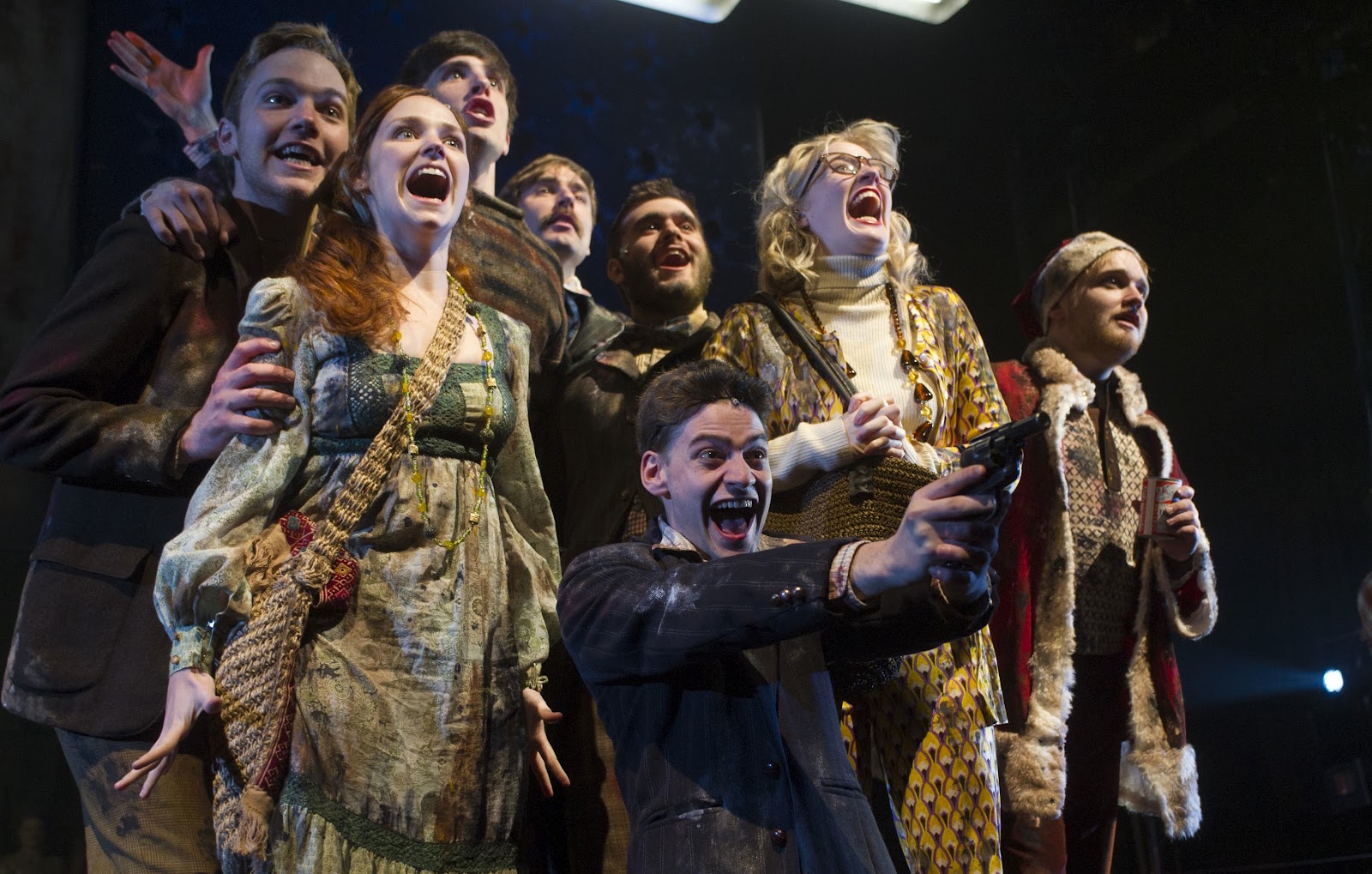
| The crazy kids of Assassins |
Not that Petosa didn't work hard - he discarded the original "Step right up and shoot the President!" staging, opting instead for a hopeless, breadline-in-the-Great-Recession mise en en scène that relied on a bullet-riddled American flag out of Jasper Johns (or maybe Nashville), and hinted that the show's assassins were being drawn right up out of the audience (i.e., the Masses). These were good ideas, but they didn't, finally, do much good; I think at this point we can safely say that Assassins is, indeed, a failure, and it's pretty obvious why: its concept may be "interesting," but it only works as an excuse for Stephen Sondheim to stretch out in a number of savage parodies (Marvin Hamlisch is neatly skewered in "Everybody's Got the Right," for instance). But this invitation to misanthropic indulgence only yields maybe two numbers that can stand up to the rest of the Sondheim canon, and in the meantime, dramatically - whoo-boy, is Assassins ever a mess.
There are so many things wrong with it, in fact, that it's hard for a critic to decide where to begin; which mistake is the central one? The show is like a sprawling network of dramaturgical error. But what leaps out at you from the history books, of course, is that America's assassins simply share no connecting thread; they don't have a communal "history," much less a "concept;" so when they speak to each other across the historical ether, as they constantly do in Assassins, there isn't really that much for them to talk about. John Wilkes Booth, for instance, was a successful, famous actor who led a racist conspiracy. But Squeaky Fromme was a pathetic lowlife who managed to consistently skirt a laundry list of crimes of really appalling sadism and squalor. Other killers were loners deranged by obvious mental, or even physical, demons, and a few could be loosely grouped as avatars of the downtrodden immigrants of the late nineteenth century. And of course Lee Harvey Oswald was a self-destructive cipher who may - or may not - have been the patsy of a kind of coup, but who certainly never communed with Booth on any assassins' astral plane, as posited here.
Although frankly, if librettist John Weidman's concept is a mess, then Petosa's is also a little murky. We get the vague idea that the whole production is intended to help us "understand" the potential assassins now obviously lurking in the Tea Party. But sorry, I'm still unsympathetic; I'm just not the type to confuse patronization with fellow feeling. And frankly, I don't even think the nutty Tea Partiers are desperately seeking celebrity; theirs is simply an evil mix of racism and ignorance, with little of the need for personal validation which is the closest Sondheim & Co. ever come to a psychological explanation for their singing shooting gallery.
This is all too bad, really, because the kids at BU did give these killers their, um, best shot, and a few scenes, particularly those between the gonzo Melissa Carter and Casey Tucker (as Sara Jane Moore and Squeaky Fromme) kind of worked. Elsewhere the singing is stronger than the acting, but things never really bog down, they just never come together, either. Evan Gambardella does throw off a weird kind of pseudo-innocent energy as both the "Balladeer" and Lee Harvey Oswald, and John Zdrojeski, as John Hinckley, hints at dramatic potential the role doesn't allow him to access. The rest of the cast is more scattershot, although everyone hits the bulls-eye here and there. Still, is that enough to float another production of Assassins? I talked briefly with director Jim Petosa about this after the show, and he argued that academic resources are better spent re-evaluating intriguingly troubled shows than in simply mounting sparkling new productions of the tried-and-true. Well - maybe. You might answer that with the observation that until a student triumphs in a true classic, he or she has no yardstick of actual success. Of course there's surely room for both options in any curriculum, I think - but in the meantime, can we please put a bullet in Assassins for good?
 |
| Lost on the Camino Real with Beau Jest. |
Beau Jest had a hit last year with another Williams one-act, the much-later Remarkable Rooming House of Madame LeMonde; but this time around, I'm afraid they only manage to confirm that Ten Blocks is an artistic traffic jam of truly epic proportions. And I mean truly EPIC proportions; this thing makes Assassins look coherent.
The scuttlebutt on the full-length version's Broadway failure has always been that director Elia Kazan forced Williams' fantasia into a naturalistic straitjacket. Having now sat through the (abbreviated) first version, I can only say I kind of admire Kazan for at least trying to wrestle this embarrassment into some kind of shape (Beau Jest just lets the pieces fall where they may). It's essentially a pretentious pastiche in which Williams' usual hobbyhorses - the stud vs. the seductress, the wisdom of the fallen queen, and of course "life" vs. "death"- all meet in a kind of car crash on some cosmic Latin highway. There are a few poetic stretches, to be sure, along with a tone of amusingly deadpan political horror. There's atmospheric Day-of-the-Dead accompaniment from a live trio that sometimes helps paste things together. But I'm afraid even when something works, it doesn't work for very long.
The Beau Jest version, directed by Davis Robinson, is nevertheless funkily likable, even though it doesn't come close to getting the dramatic job done. The basic problem is that these folks are essentially very smart comedians - so they nail the droll asides that Williams often wickedly slips into, but can't really convey at all the "wild and moving" sense of dramatic freedom the playwright thought he was unleashing. Gypsies re-growing their maidenheads as they dance wildly in the moonlight, death as a form of orgasm - sorry, much as I love 'em, this just ain't Beau Jest; imagine the Flight of the Conchords trying to do Blood Wedding and you've got roughly the situation here. As expected, the comic scenes - particularly an amusing shakedown by the local fortune teller - worked best; the orgasmic flights toward inevitable Death, less so. And then there were the ridiculous interpolations from Cervantes, Proust, and others (Don Quixote AND the Baron de Charlus both wander through!); Beau Jest offered a weak smile here at the playwright's own pretensions (Williams is hardly on a par with either writer), but couldn't make much more of these interludes.
Oh, well. I suppose I'm glad that I've seen this rarity, but I can't honestly say I'd willingly sit through it again. And perhaps it's time we began to formulate a critical approach - or even a mode of intervention - toward the temptations of the "interesting failure." A first precept might be to resist the illusion that audiences of the past were necessarily philistines (and at any rate, let's face it, even philistines sometimes have a point). The second might be to question the true "interest"of a failure that only rehashes, or just plain hashes, elements which reach obvious fruition - or at least balance - in an artist's other, successful works (as is the case with Ten Blocks). I mean, is it so "interesting" to discover that a particular gambit works in one way, but not another? Perhaps to an academic - but rarely to an audience.


