|
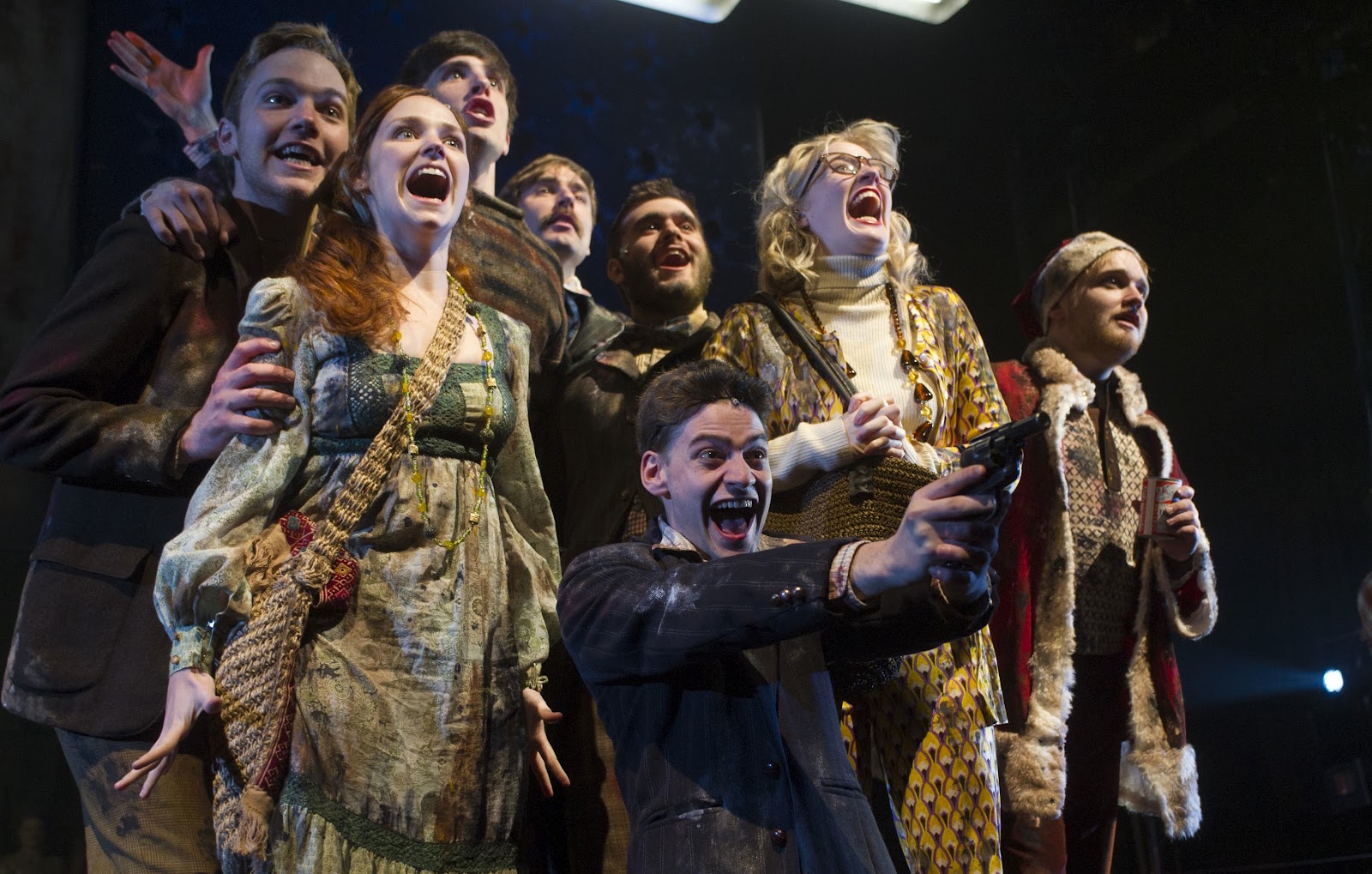
| Tim Spears as Mozart reacts to Salieri's machinations. Photos: Andrew Brilliant. |
Peter Shaffer's biggest hit, Amadeus (now at the New Rep through May 19), a highly fictionalized account of the relationship between composers Antonio Salieri and Wolfgang Amadeus Mozart, is oft described as a battle royale between genius (Mozart) and mediocrity (Salieri).
Which is good enough, I suppose, as far as it goes. But it leaves out one crucial fact.
Which is that playwright Peter Shaffer himself is - well, something of a mediocrity. Smart but not insightful, learned but rarely wise, Shaffer made a career out of seemingly criticizing small-mindedness while all the time indulging it.
Thus Shaffer's play works as a kind of pseudo-intellectual stand-up, but never really gets anywhere as drama - for his Salieri is all bitter one-liners; he's a tragic character sans anagnorisis (that is, epiphany); and his Mozart remains clueless to the end, too. Indeed, once the playwright lays out his mildly clever premise (that the jealously aloof Salieri poisoned brilliant-but-boorish Mozart as some sort of cosmic revenge on God), he can only work more and more tedious variations on his set-up, and never really digs beneath his own assumptions. In a way, it's as if Shaffer has constructed one of those Nabokovian follies, like Pale Fire, in which the lead character is unaware he is creating a devastating self-critique - but unfortunately Shaffer leaves the audience in the dark about it, too.
That gap has not prevented the play from being popular, though - people love its heavy irony, its Man-for-All-Seasons-level theology, and the way it gives them credit for artistic insights they wouldn't really have had on their own. But then the music of Salieri once wowed the crowds as well (although what that says about Shaffer's blockbuster I think the playwright may have never pondered).
That gap has not prevented the play from being popular, though - people love its heavy irony, its Man-for-All-Seasons-level theology, and the way it gives them credit for artistic insights they wouldn't really have had on their own. But then the music of Salieri once wowed the crowds as well (although what that says about Shaffer's blockbuster I think the playwright may have never pondered).
Not that Amadeus isn't snarky fun. It is - for a while, at least (alas, the second act treads water). And certainly the New Rep has pulled out all the stops to put this middlebrow magnum opus over; they've mustered a large cast, a bold set, sumptuous costumes - the works.
But even at its best, the play is only a vehicle - a tandem vehicle, perhaps, festooned with Broadway bells and whistles (and to be fair, many witty references to Mozart's oeuvre) but still a vehicle. As Salieri never develops into more than a stick figure, and Mozart remains a clown, the success of Amadeus boils down to its casting. Essentially, if you have charismatic actors who are perfect for these roles, and can keep burrowing into them for three hours, a production can coast to the finish line on their star power.
But the New Rep hasn't been quite that lucky. They're halfway home with Tim Spears' Mozart; he doesn't push the role's scatological jokes, and generally conveys a touchingly innocent, if infantile, vulnerability. I have seen at least one Mozart who conjured from scraps in the script a growing awareness that God was basically as cold to him as he was to Salieri; but that was an exceptional case. Spears is the best reason to see this show.
As Salieri, local star Benjamin Evett isn't as compelling, but this is almost an accident of casting - Thomas Derrah, a better fit for the role, reportedly withdrew from the production, and Evett graciously stepped in. But Evett's easy-going, roguish stage presence is almost the opposite of what you'd want in Salieri (which is intended as a compliment); Evett has always been at his best playing confident, cocky dudes; if anything he should be playing Mozart, too.
But he's stuck with the lead (left), and he does make a go of it in the play's stronger first half, which also contains most of Shaffer's best set-pieces, such as the moment Mozart makes mincemeat of a trudging Salieri march (just btw, Salieri wasn't all that bad - judge for yourself). In short, Evett can do indignation. He has more trouble with envy - but the secret handshake between envy and piety is essentially the sine qua non of the part. Particularly as Salieri seems so block-headed.
At the very top, the composer is clueless enough to offer God a deal (while God, as I recall, only makes deals on his own terms): in exchange for a pious life of Christian decorum, Salieri expects to be accorded fame (note he doesn't ask for talent). And God does grant him celebrity - He keeps his end of the bargain - but He also gives him Mozart, talented beyond measure, despite flaunting all the proprieties that Salieri staked his soul on. It's a pretty obvious life-lesson, but the scales never fall from Salieri's eyes. Instead, actually insulted, he embarks on a "war" with Jehovah (guess who wins?).
And so Shaffer's script devolves into a tedious chess game in which Salieri is always one move behind the Almighty. But imagine how interesting Amadeus might have been if the emotionally crippled court composer changed his mind (after all, he's destroying the source of the music he adores, even fetishizes) - yet was unable to stop the cruel wheels he had set in motion? Or what if Salieri began to appreciate his own evil, began to worry for his own soul (given his faith in God's presence, this seems all but inevitable?). In any number of ways, Amadeus could grip us to the end.
But no such luck. Schaffer tends to rigidly replicate a certain template (basically, a conventional bureaucrat destroys an ecstatic), and he elaborates that trope here, but can't transcend it. So the cast at the New Rep does its best to pretend that we're still interested in the latest iteration of Salieri's hopeless battle royale (it's a bit like watching a Roadrunner cartoon in powdered wigs that runs for three hours).
Still, certainly there's plenty of talent on the stage, and director Jim Petosa keeps things moving with flair, although again, subtle casting issues sometimes undermine everyone's best efforts. The lovely and talented McCaela Donovan, for instance, looks far too elegant in Frances Nelson McSherry's gowns for us to believe she'd ever go slumming with the likes of Mozart. It's likewise a pleasure to see the gorgeous Esme Allen on stage again, but she's actually far too good for the part she's got. On the plus side, Paula Langton makes an impression as one of Schaffer's gossips, as do Paul Farwell and Jeffries Thaiss as various over-dressed courtiers. And Russell Garrett puts an amusingly precise spin on the stupidity of Joseph II.
So there is always someone to watch on stage - and you can even admire the stage itself, too. The costuming, as I've mentioned, is lavish, while Mary Ellen Stebbins' lighting is always imaginative. And Cristina Todesco's set is quite brilliant: it features a central oculus - God's eye, literally - from which Mozart tumbles like a mote, and from which emanates the music of the spheres (its lid even turns out to be a cathedral's rose window). I wish Shaffer's play was worth the efforts of all these talented people. But apparently that wasn't God's plan.
 |
| Benjamin Evett comes to grips with Mozart's genius. |
At the very top, the composer is clueless enough to offer God a deal (while God, as I recall, only makes deals on his own terms): in exchange for a pious life of Christian decorum, Salieri expects to be accorded fame (note he doesn't ask for talent). And God does grant him celebrity - He keeps his end of the bargain - but He also gives him Mozart, talented beyond measure, despite flaunting all the proprieties that Salieri staked his soul on. It's a pretty obvious life-lesson, but the scales never fall from Salieri's eyes. Instead, actually insulted, he embarks on a "war" with Jehovah (guess who wins?).
And so Shaffer's script devolves into a tedious chess game in which Salieri is always one move behind the Almighty. But imagine how interesting Amadeus might have been if the emotionally crippled court composer changed his mind (after all, he's destroying the source of the music he adores, even fetishizes) - yet was unable to stop the cruel wheels he had set in motion? Or what if Salieri began to appreciate his own evil, began to worry for his own soul (given his faith in God's presence, this seems all but inevitable?). In any number of ways, Amadeus could grip us to the end.
But no such luck. Schaffer tends to rigidly replicate a certain template (basically, a conventional bureaucrat destroys an ecstatic), and he elaborates that trope here, but can't transcend it. So the cast at the New Rep does its best to pretend that we're still interested in the latest iteration of Salieri's hopeless battle royale (it's a bit like watching a Roadrunner cartoon in powdered wigs that runs for three hours).
Still, certainly there's plenty of talent on the stage, and director Jim Petosa keeps things moving with flair, although again, subtle casting issues sometimes undermine everyone's best efforts. The lovely and talented McCaela Donovan, for instance, looks far too elegant in Frances Nelson McSherry's gowns for us to believe she'd ever go slumming with the likes of Mozart. It's likewise a pleasure to see the gorgeous Esme Allen on stage again, but she's actually far too good for the part she's got. On the plus side, Paula Langton makes an impression as one of Schaffer's gossips, as do Paul Farwell and Jeffries Thaiss as various over-dressed courtiers. And Russell Garrett puts an amusingly precise spin on the stupidity of Joseph II.
So there is always someone to watch on stage - and you can even admire the stage itself, too. The costuming, as I've mentioned, is lavish, while Mary Ellen Stebbins' lighting is always imaginative. And Cristina Todesco's set is quite brilliant: it features a central oculus - God's eye, literally - from which Mozart tumbles like a mote, and from which emanates the music of the spheres (its lid even turns out to be a cathedral's rose window). I wish Shaffer's play was worth the efforts of all these talented people. But apparently that wasn't God's plan.