Showing posts with label Stephen Sondheim. Show all posts

Monday, January 14, 2013

Side bi Side by Sondheim

Phil Tayler and Erica Spyres in Marry Me a Little.  I think they're both heterosexual here.
You know what's great about Boston theatre right now?  The talent pool has gotten so deep that even when shows don't really work, they somehow kind of work anyway.

Take Stephen Sondheim's Marry Me a Little (at the New Rep through January 27). Director Ilyse Robbins has decided to experiment with this intimate little revue, which was conjured after the triumph of Sweeney Todd to showcase the "trunk songs" cut from previous Sondheim efforts.

Now back in 1980, the original creative team (Craig Lucas and Norman René) teased from the melancholy of this material a winsome tale of two singles singing to themselves of love when the only thing keeping them apart was the common wall of their respective apartments.  (The kicker was that in the end, they didn't even meet!)

Revivals have since toyed with that concept - one recent version ditched the original's hetero beard completely and featured two gay men.  But Robbins has instead doubled the initial couple to a quartet, and turned some (but not all) of these numbers into same-sex torch songs.  (Which, let's be honest, they probably were when old Stevie first hummed them to himself!)  So now I guess the revue could be called "Gay-Marry Me a Little."

Ba-doom-boom!  All right, settle down, I know I shouldn't snicker.  But the thing is - well, a funny thing happened on the way to the millennium.  Being gay got a little boring to a lot of people.  Even some gay people.  Maybe even to a few fundamentalists!

So somehow Robbins' innovative new take . . . well, it seems designed for middle-aged straights who are, you know, all "down with the gays."  Not that there's anything wrong with that!  And it is a sweet gesture.  But us actual gays, I think, are gonna be wondering, "So - are they all like in a bisexual bathhouse, or what?"  Because one minute the guys are singing to girls, and the next they're singing to other guys, and then they're back singing to the girls again (who are sometimes singing to each other). Are they different characters from song to song?, we wonder vaguely - or are they just jumping the fence over and over?  (I mean I had a boyfriend like that back in college, and things did not work out!)

Still, props to Robbins and the New Rep for you know, being down with us queers - and it doesn't really matter if the concept is a little confusing; the performers make it work song by song. Which brings me back to my first point - once again I've found myself watching a cast that easily negotiated issues and funny twists that would have sent Boston's best pros spinning only a decade ago. The quartet here - Aimee Doherty, Phil Tayler, Erica Spyres and newcomer Brad Daniel Peloquin - all have delightful voices and acting chops to spare.  Peloquin, often perched on the top level of a sprawling set, sometimes had projection issues (the actors were wearing mikes, but the amplification, if it was there at all, was blessedly subtle) - but in general the singing was wonderful, and the vignettes accompanying the songs ran the gamut from haunting to hilarious.

Boston's most fabulous leading lady? Photo(s) by Andrew Brilliant.
Doherty (at left) was in particularly fine form throughout; this lovely lady has matured into our most confidently fabulous musical comedy star. She has it all - a glorious belt, sparkling top notes, and a delicious comic swagger - plus a special kind of girlfriend-sympathy with director Robbins' witty but broad gags.  Thus her take on "Saturday Night" (from the early Sondheim opus of the same name) was a poignant and priceless delight.

But if Doherty was all bright, polished brass, then Spyres was pure gold, once more delivering a kind of glowing sweetness in her vocals (when she wasn't accompanying the rest of the cast on violin!). She perhaps shone brightest in the heart-breaking "Rainbows," a duet she shared with musical-comedy soulmate Phil Tayler, who now has worked opposite her in three shows in a row, and who is also an astonishingly sincere and versatile performer.  This is (if anyone's counting) the fourth riveting performance from Tayler within a year; here he almost whispers a few songs, a move that would be daring if he didn't have the kind of presence that can focus the attention of an entire house.  As I mentioned, Peloquin seemed the least technically assured of the quartet - but if anything he was actually closest to the Sondheim "type," and when he found his vocal power, his delicate, flexible tenor was beautifully pure.  All four found accomplished support in the double-piano accompaniment of David McGory and Todd C. Gordon, who seemed to be playing away in their own apartments (in a clever stroke, their neighbors would occasionally bang on the walls when things got too loud).

The songs themselves, of course, will fascinate the composer's fans, but also appeal to those less familiar with the arc of his achievement. Tunes like "Happily Ever After" tease the Sondheim specialist with their echoes of hits like "Being Alive;" meanwhile curiosities like "Pour le Sport" remind us of just how quirky his lyrics could become.  But numbers laced with double entendres, like "Can That Boy F-oxtrot!" are a kind of universal musical-theatre language, and I think Sondheim's torch songs smolder for everybody.  In the end, that's Robbins' point: heartbreak feels the same whoever is the cause.

Wednesday, May 16, 2012

Sometimes "interesting failures" are still just failures . . .

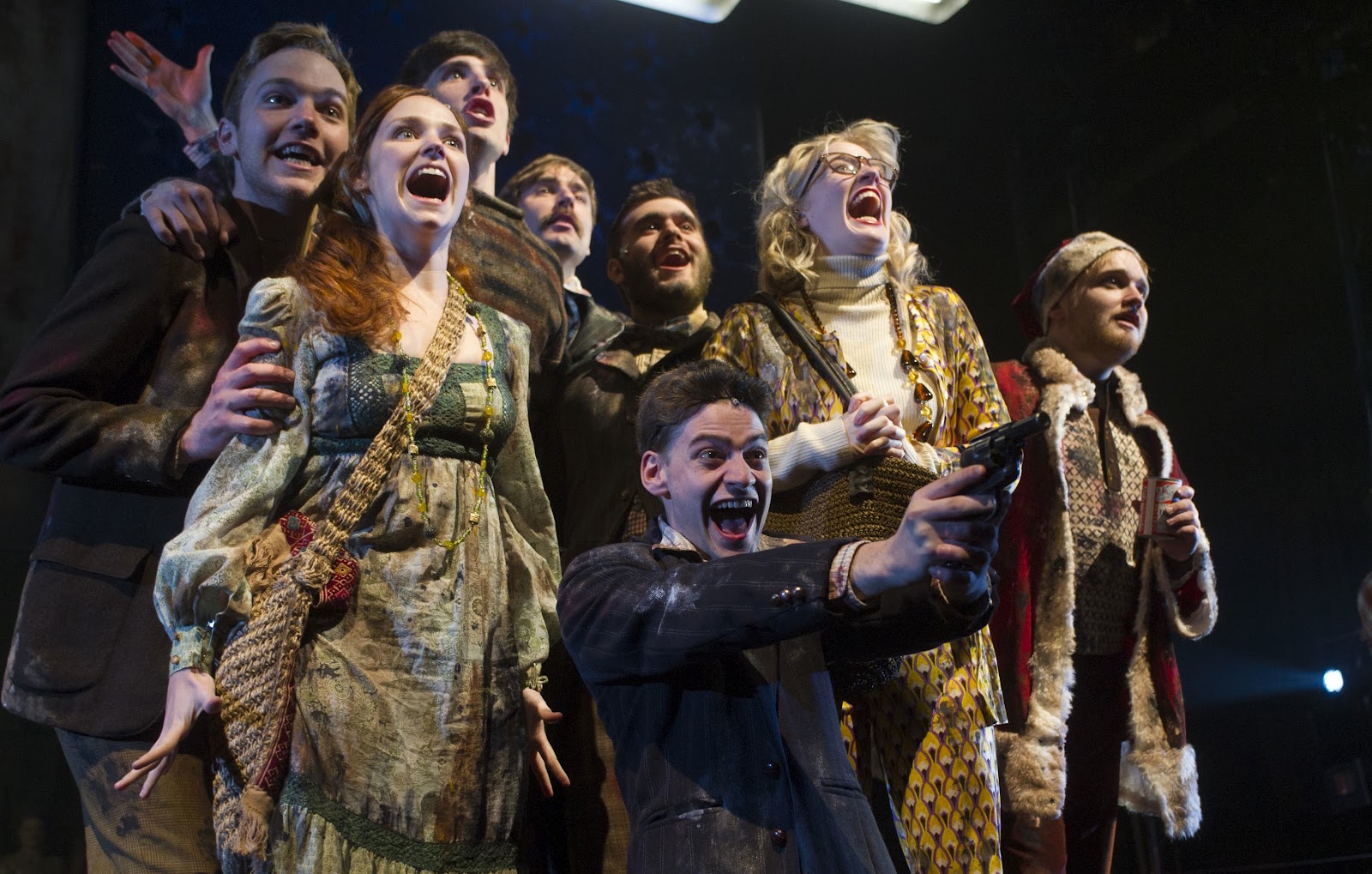
The crazy kids of Assassins
Ah, the "interesting failure."  Every major theatrical artist has one, even Shakespeare - and Stephen Sondheim has a couple - among which Assassins, from 1990, has always been particularly prominent.  I think there's just something so outré about the concept of this revue (I guess it's a revue) that it has exerted a kind of siren call over the musical theatre even though - well, by now we know it really doesn't work.  I mean a musical about assassins?? That's got to be interesting, right?  Well, it failed interestingly at its premiere, and then it failed a little less interestingly in a New York revival, too.  It likewise failed - perhaps even less interestingly - in several regional productions.  And now it has failed again, exuding only a mild level of interest, in a production by the BU School of Theatre, under the direction of Jim Petosa, which closed last weekend.  (I know, another post-mortem - but I'm almost caught up.)

Not that Petosa didn't work hard - he discarded the original "Step right up and shoot the President!" staging, opting instead for a hopeless, breadline-in-the-Great-Recession mise en en scène that relied on a bullet-riddled American flag out of Jasper Johns (or maybe Nashville), and hinted that the show's assassins were being drawn right up out of the audience (i.e., the Masses).  These were good ideas, but they didn't, finally, do much good; I think at this point we can safely say that Assassins is, indeed, a failure, and it's pretty obvious why: its concept may be "interesting," but it only works as an excuse for Stephen Sondheim to stretch out in a number of savage parodies (Marvin Hamlisch is neatly skewered in "Everybody's Got the Right," for instance).  But this invitation to misanthropic indulgence only yields maybe two numbers that can stand up to the rest of the Sondheim canon, and in the meantime, dramatically - whoo-boy, is Assassins ever a mess.

There are so many things wrong with it, in fact, that it's hard for a critic to decide where to begin; which mistake is the central one?  The show is like a sprawling network of dramaturgical error.  But what leaps out at you from the history books, of course, is that America's assassins simply share no connecting thread; they don't have a communal "history," much less a "concept;" so when they speak to each other across the historical ether, as they constantly do in Assassins, there isn't really that much for them to talk about.  John Wilkes Booth, for instance, was a successful, famous actor who led a racist conspiracy.  But Squeaky Fromme was a pathetic lowlife who managed to consistently skirt a laundry list of crimes of really appalling sadism and squalor.  Other killers were loners deranged by obvious mental, or even physical, demons, and a few could be loosely grouped as avatars of the downtrodden immigrants of the late nineteenth century.  And of course Lee Harvey Oswald was a self-destructive cipher who may - or may not - have been the patsy of a kind of coup, but who certainly never communed with Booth on any assassins' astral plane, as posited here.

Although frankly, if librettist John Weidman's concept is a mess, then Petosa's is also a little murky.  We get the vague idea that the whole production is intended to help us "understand" the potential assassins now obviously lurking in the Tea Party.  But sorry, I'm still unsympathetic;  I'm just not the type to confuse patronization with fellow feeling. And frankly, I don't even think the nutty Tea Partiers are desperately seeking celebrity; theirs is simply an evil mix of racism and ignorance, with little of the need for personal validation which is the closest Sondheim & Co. ever come to a psychological explanation for their singing shooting gallery.

This is all too bad, really, because the kids at BU did give these killers their, um, best shot, and a few scenes, particularly those between the gonzo Melissa Carter and Casey Tucker (as Sara Jane Moore and Squeaky Fromme) kind of worked.  Elsewhere the singing is stronger than the acting, but things never really bog down, they just never come together, either.  Evan Gambardella does throw off a weird kind of pseudo-innocent energy as both the "Balladeer" and Lee Harvey Oswald, and John Zdrojeski, as John Hinckley, hints at dramatic potential the role doesn't allow him to access.  The rest of the cast is more scattershot, although everyone hits the bulls-eye here and there.  Still, is that enough to float another production of Assassins?  I talked briefly with director Jim Petosa about this after the show, and he argued that academic resources are better spent re-evaluating intriguingly troubled shows than in simply mounting sparkling new productions of the tried-and-true.  Well - maybe.  You might answer that with the observation that until a student triumphs in a true classic, he or she has no yardstick of actual success. Of course there's surely room for both options in any curriculum, I think - but in the meantime, can we please put a bullet in Assassins for good?

Lost on the Camino Real with Beau Jest.
But alas, the BU Theatre Department hasn't been the only local troupe sipping the "interesting failure" Kool-Aid of late. Across town, at the indomitable Charlestown Working Theater, the widely-respected Beau Jest is currently (no, this is not a post-mortem, it runs through next weekend) attempting to revive Ten Blocks on the Camino Real, the one-act source of perhaps Tennessee Williams' most legendary Broadway bomb, Camino Real.

Beau Jest had a hit last year with another Williams one-act, the much-later Remarkable Rooming House of Madame LeMonde; but this time around, I'm afraid they only manage to confirm that Ten Blocks is an artistic traffic jam of truly epic proportions. And I mean truly EPIC proportions; this thing makes Assassins look coherent.

The scuttlebutt on the full-length version's Broadway failure has always been that director Elia Kazan forced Williams' fantasia into a naturalistic straitjacket. Having now sat through the (abbreviated) first version, I can only say I kind of admire Kazan for at least trying to wrestle this embarrassment into some kind of shape (Beau Jest just lets the pieces fall where they may). It's essentially a pretentious pastiche in which Williams' usual hobbyhorses - the stud vs. the seductress, the wisdom of the fallen queen, and of course "life" vs. "death"- all meet in a kind of car crash on some cosmic Latin highway. There are a few poetic stretches, to be sure, along with a tone of amusingly deadpan political horror. There's atmospheric Day-of-the-Dead accompaniment from a live trio that sometimes helps paste things together.  But I'm afraid even when something works, it doesn't work for very long.

The Beau Jest version, directed by Davis Robinson, is nevertheless funkily likable, even though it doesn't come close to getting the dramatic job done. The basic problem is that these folks are essentially very smart comedians - so they nail the droll asides that Williams often wickedly slips into, but can't really convey at all the "wild and moving" sense of dramatic freedom the playwright thought he was unleashing. Gypsies re-growing their maidenheads as they dance wildly in the moonlight, death as a form of orgasm - sorry, much as I love 'em, this just ain't Beau Jest; imagine the Flight of the Conchords trying to do Blood Wedding and you've got roughly the situation here. As expected, the comic scenes - particularly an amusing shakedown by the local fortune teller - worked best; the orgasmic flights toward inevitable Death, less so. And then there were the ridiculous interpolations from Cervantes, Proust, and others (Don Quixote AND the Baron de Charlus both wander through!); Beau Jest offered a weak smile here at the playwright's own pretensions (Williams is hardly on a par with either writer), but couldn't make much more of these interludes.

Oh, well. I suppose I'm glad that I've seen this rarity, but I can't honestly say I'd willingly sit through it again. And perhaps it's time we began to formulate a critical approach - or even a mode of intervention - toward the temptations of the "interesting failure." A first precept might be to resist the illusion that audiences of the past were necessarily philistines (and at any rate, let's face it, even philistines sometimes have a point). The second might be to question the true "interest"of a failure that only rehashes, or just plain hashes, elements which reach obvious fruition - or at least balance - in an artist's other, successful works (as is the case with Ten Blocks). I mean, is it so "interesting" to discover that a particular gambit works in one way, but not another? Perhaps to an academic  - but rarely to an audience.

Wednesday, August 10, 2011

Guess who else hates Diane Paulus?

The arts blog at the Times has printed a letter Stephen Sondheim (left) has sent to the editor regarding its fawning coverage of Diane Paulus's "updating" of Porgy and Bess. And boy, does our leading musical-theatre genius ever nail Harvard's leading theatrical poseur to the wall.  The text of the letter is below (go to the blog to read the 95 comments, almost all of which echo Sondheim's concerns). Of course I've been railing about Paulus's upcoming molestation of Porgy and Bess since I first heard about it, months ago (indeed, my comments regarding it played a part in my resignation from the IRNEs). But it's nice to have such high profile back-up! I'm not sure which organization Harvard can force Stephen Sondheim to resign from, but I'm sure some such effort is now afoot . . .

But without further ado, on to the letter itself:

The article by Mr. Healy about the coming revival of “Porgy and Bess” is dismaying on many levels. To begin with, the title of the show is now “The Gershwins’ Porgy and Bess.” I assume that’s in case anyone was worried it was the Rodgers and Hart “Porgy and Bess” that was coming to town. But what happened to DuBose Heyward? Most of the lyrics (and all of the good ones) are his alone (“Summertime,” “My Man’s Gone Now”) or co-written with Ira Gershwin (“Bess, You Is My Woman Now”). If this billing is at the insistence of the Gershwin estate, they should be ashamed of themselves. If it’s the producers’ idea, it’s just dumb. More dismaying is the disdain that Diane Paulus, Audra McDonald and Suzan-Lori Parks feel toward the opera itself.

Ms. Paulus says that in the opera you don’t get to know the characters as people. Putting it kindly, that’s willful ignorance. These characters are as vivid as any ever created for the musical theater, as has been proved over and over in productions that may have cut some dialogue and musical passages but didn’t rewrite and distort them.

What Ms. Paulus wants, and has ordered, are back stories for the characters. For example she (or, rather, Ms. Parks) is supplying Porgy with dialogue that will explain how he became crippled. She fails to recognize that Porgy, Bess, Crown, Sportin’ Life and the rest are archetypes and intended to be larger than life and that filling in “realistic” details is likely to reduce them to line drawings. It makes you speculate about what would happen if she ever got her hands on “Tosca” and ‘Don Giovanni.” How would we get to know them? Ms. Paulus would probably want to add an aria or two to explain how Tosca got to be a star, and she would certainly want some additional material about Don Giovanni’s unhappy childhood to explain what made him such an unconscionable lecher.

Then there is Ms. Paulus’s condescension toward the audience. She says, “I’m sorry, but to ask an audience these days to invest three hours in a show requires your heroine be an understandable and fully rounded character.” I don’t know what she’s sorry about, but I’m glad she can speak for all of us restless theatergoers. If she doesn’t understand Bess and feels she has to “excavate” the show, she clearly thinks it’s a ruin, so why is she doing it? I’m sorry, but could the problem be her lack of understanding, not Heyward’s?

She is joined heartily in this sentiment by Ms. McDonald, who says that Bess is “often more of a plot device than a full-blooded character.” Often? Meaning sometimes she’s full-blooded and other times not? She’s always full-blooded when she’s acted full-bloodedly, as she was by, among others, Clamma Dale and Leontyne Price. Ms. McDonald goes on to say, “The opera has the makings of a great love story … that I think we’re bringing to life.” Wow, who’d have thought there was a love story hiding in “Porgy and Bess” that just needed a group of visionaries to bring it out?

Among the ways in which Ms. Parks defends the excavation work is this: “I wanted to flesh out the two main characters so that they are not cardboard cutout characters” and goes on to say, “I think that’s what George Gershwin wanted, and if he had lived longer he would have gone back to the story of ‘Porgy and Bess’ and made changes, including the ending.”

It’s reassuring that Ms. Parks has a direct pipeline to Gershwin and is just carrying out his work for him, and that she thinks he would have taken one of the most moving moments in musical theater history — Porgy’s demand, “Bring my goat!” — and thrown it out. Ms. Parks (or Ms. Paulus) has taken away Porgy’s goat cart in favor of a cane. So now he can demand, “Bring my cane!” Perhaps someone will bring him a straw hat too, so he can buck-and-wing his way to New York.

Or perhaps in order to have her happy ending, she’ll have Bess turn around when she gets as far as Philadelphia and return to Catfish Row in time for the finale, thus saving Porgy the trouble of his heroic journey to New York. It will kill “I’m on My Way,” but who cares?

Ms. McDonald immediately dismisses any possible criticism by labeling anyone who might have objections to what Ms. Paulus and her colleagues are doing as “Gershwin purists” — clearly a group, all of whom think alike, and we all know what a “purist” is, don’t we? An inflexible, academic reactionary fuddy-duddy who lacks the imagination to see beyond the author’s intentions, who doesn’t recognize all “the holes and issues” that Ms. Paulus and Ms. McDonald and Suzan-Lori Parks do. Never fear, though. They confidently claim that they know how to fix this dreadfully flawed work.

I can hear the outraged cries now about stifling creativity and discouraging directors who want to reinterpret plays and musicals in order to bring “fresh perspectives,” as they are wont to say, but there is a difference between reinterpretation and wholesale rewriting. Nor am I judging this production in advance, only the attitude of its creators toward the piece and the audience. Perhaps it will be wonderful. Certainly I can think of no better Porgy than Norm Lewis nor a better Bess than Audra McDonald, whose voice is one of the glories of the American theater. Perhaps Ms. Paulus and company will have earned their arrogance.

Which brings me back to my opening point. In the interest of truth in advertising, let it not be called “The Gershwins’ Porgy and Bess,” nor even “The Gershwin-Heyward Porgy and Bess.” Advertise it honestly as “Diane Paulus’s Porgy and Bess.” And the hell with the real one.

Monday, June 21, 2010

The uses of entertainment


Cinderella (McCaela Donovan) ventures "into the woods."

I suppose Into the Woods isn't quite top-drawer Sondheim; that is, it's not in the magic circle of Company, Follies, A Little Night Music, and Sweeney Todd. It's slightly less virtuosic, slightly less ground-breaking.

But it's also produced more often than the "Big Four" - I think we've seen three different productions in the last few years here in Boston, in fact. Why? Perhaps because it's not too challenging, and not too dark - like Goldilocks's porridge (to borrow a fairy-tale metaphor), in terms of challenge, it's just right. Plus it's studded with some of the master's loveliest melodies, including "No One is Alone" and "Children Will Listen," as well as the happy, mindless march that powers the title tune.

So I was happy to welcome yet another Into the Woods into the woods around Waltham - and happier still to find the recently re-christened "Reagle Music Theatre of Greater Boston" (I think we'll shorten that to "Reagle Music Theatre") has mounted a moving and sophisticated (if not flawless) version. It's powered by two knock-out performances, from Broadway vet Rachel York (below left, as the Witch) and relative-newcomer McCaela Donovan (above, as Cinderella), and boasts a nearly-as-strong supporting cast. At the same time, the company seems to have made a jump in its production values, too: the set, by Janie Howland, is more sophisticated and conceptual than was typical for the glitzy, but literal-minded "Reagle Players" (although the design has a few problems, more on that later), and the orchestra, led by musical director Charles Peltz, sounded much cleaner and more cohesive than it has in times past; in fact, in one leap, Reagle has landed in the landscape of a typical SpeakEasy, Lyric, or New Rep musical.

Okay, back to the show itself. Just in case you're a Sondheim virgin, Into the Woods was inspired by Bruno Bettelheim's 1976 blockbuster The Uses of Enchantment, which analyzed the tales of the Brothers Grimm in terms of child psychology - in a word, how the stories allowed kids to grapple with subconscious desires and fears at one remove. With librettist James Lapine, Sondheim set about producing a similar set of fairy tales for grown-ups, in which adult issues could be dealt with via a similar code.

Just after the success of Into the Woods, of course, Bettelheim committed suicide, and soon his reputation endured blow after blow. Still, the common-sense basis of The Uses of Enchantment remains a cultural touchstone, perhaps due in no small part to Sondheim - and the way he and Lapine wittily extended the fairy tale into a more complex moral universe. In their show's first half, four famous stories (Cinderella, Rapunzel, Jack and the Beanstalk, and Little Red Riding Hood) are braided together via the device of the Baker and his Wife, who are seeking talismans to lift a curse of sterility visited on them by a wicked Witch. All the figures of the various stories intersect and interact in those eponymous "woods" - a metaphorical site of fear and desire, of moral uncertainty and fraught encounter, in which circumstances and even identity are constantly shifting.

The twist in Into the Woods is that once these fairy tales are "finished" - and everyone has achieved their wish - the story goes on: all that self-actualization has resulted in a new catastrophe, in which a vengeful giantess (widely interpreted as a personification of the AIDS crisis) appears to mow down the population. Thus as it makes the leap from the 70's to the 80's, Into the Woods likewise limns the transition from adolescence to maturity, and from individual to community - and of course, the awareness of the multiple moral perspectives that transition entails.

If that sounds like a lot to swallow in an evening's entertainment, rest assured that Sondheim and Lapine make the morals go down easy. I'm sure plenty of people have enjoyed Into the Woods without pondering any of this. What's memorable about the Reagle version, however, is how it subtly grows in scale and power as it proceeds: by the finale, largely thanks to McCaela Donovan's delicately devastating version of "No One is Alone," I confess my heart was in my throat - right where Sondheim and Lapine intended it to be.

Prior to that, there were a few bumps on the path to grandmother's house. The first act of Woods is famously intricate, with a book that starts and stops repeatedly as librettist Lapine weaves together his separate tales with Sondheim's many songs. At Reagle, at least on opening weekend, all this didn't quite cohere - subtle gaps and beats kept slowing things down, and at the same time the advance of the "First" and "Second" Midnights didn't quite register. The set - a striking statement in which trees would descend onto the pages of an open book - didn't seem to help things; several actors tripped over its steps, and it seemed to subtly frustrate director Stacey Stephens's attempts at flow. Still, in the more simply-structured second act, things improved, and the assembled ensemble shown all the brighter.

Chief among these many lights was Rachel York, a Broadway vet (and Reagle regular) without a real peer in Boston in terms of musical theatre ability. She won the IRNE for last summer's Hello, Dolly!, and something tells me she'll be back in contention next spring for her work here; her Witch is both hilariously broad and yet - amazingly - deeply touching; her rendition of "Stay with Me" was the most wrenching I've ever heard, in fact. Damn, this gal has chops.


The surviving - I mean supporting - cast of this grim fairy tale - Gregory Isaac Stone, McCaela Donovan, Doug Jabara and Allison Russell.

Barely a step behind York, however - despite those glass slippers - was local star McCaela Donovan as Cinderella. Donovan recently impressed as Yum-Yum in the New Rep's Hot Mikado, and she carried on - after a slightly-subdued start - at the same high level here; as noted, I'll never forget her take on "No One is Alone;" with any justice, it would become the standard version.

The supporting cast likewise glittered - I particularly savored the subtle acting and rich singing voices of Shannon Lee Jones and Doug Jabara as the Baker and his Wife, as well as Allison Russell's satisfied sense of happy appetite as the obnoxious Little Red Riding Hood. Alas, Ayal Miodovnik was somewhat hampered as the Big Bad Wolf by a cumbersome mask, but he was a lot of fun as the fatuously swaggering Prince, and newcomers Gregory Isaac Stone and Brennan Roach impressed as Jack and Rapunzel's Prince, respectively.

There were a few gaps in the ensemble - Catherine Lee Christie contributed a fine singing voice but not much more as Jack's mother, and in the part of the Narrator, local TV personality Scott Wahle came off as - well, a local TV personality (his costume of anchorman-suit-and-tie didn't help things); to be fair, Wahle was better, but hardly outstanding, as the script's "mysterious old man."

These missteps were forgotten, however, amid the production's many pleasures. In fact, I'd say the other theatres in town should watch their backs; as I predicted last summer, Reagle seems to see an opening for a jump from a "merely" community-based theatre into a full-fledged regional presence, and with Into the Woods, they're putting their best foot forward.

Tuesday, November 17, 2009

He's the sphinx of American musical theatre; at 79, a kind of relic of the heroic past. He was mentored by Oscar Hammerstein; knew and worked with Richard Rodgers, Leonard Bernstein, and Jerome Robbins; penned 'a nervous breakdown' for Ethel Merman, a Broadway break-out for Chita Rivera, and unforgettable roles for Elaine Stritch and Angela Lansbury. In the process, he re-invented the form of musical theatre again and again. And again. And again.

"He," of course, is Stephen Sondheim, one of the few acknowledged geniuses on the planet, and a man whose theatrical career knows few parallels. He is either the lyricist or composer (or both) of five of the best musicals ever made: West Side Story, Gypsy, Company, Follies, and Sweeney Todd, and the creator of several more that are nearly as great. He owns an Oscar, several Grammys, a Pulitzer, and nine Tonys. His achievement is poignant in only one respect: once hailed as a harbinger of the future, he is now understood to be the last of his kind; not the prophet of a new age, but the apotheosis of an old one.

And he came to Boston last weekend, in the company of former New York Times drama critic Frank Rich, as part of the Celebrity Series fall season. Needless to say, it was wonderful to simply see him in the flesh; Sondheim looked spry, and his voice and manner could have been those of a man twenty years younger. Certainly his wit was as sharp and focused as ever, and it was easy to imagine that whatever the eventual fate of Road Show (the lengthily-developed project which has yet to see Broadway), Sondheim could, perhaps, still have another great musical in him - whatever doubts he himself may have expressed about that!

Still, over the course of the conversation, I'm afraid the sphinx kept all his secrets (something that Sondheim has always been famous for doing). Not that anyone expects this kind of celebrity ritual to turn into a confession. Still, Sondheim's history, both artistic and personal, is so rich that I think Rich could have mined a few more insights - or at least heretofore-unknown quotes - than he did; a perusal of just Sondheim's Wikipedia entry is far more fascinating than their repartee turned out to be (the young Sondheim in a professional portrait, above). And the conversation often wandered into odd critical pronouncements that were about as eccentric as you might expect of Stephen Sondheim; is Sweeney Todd really the "only film musical designed for film"?? Is Ravel really the source of Broadway's musical style??

Okay, so Sondheim's not much of a critic, and perhaps his and Rich's act has become something of a routine (they've taken it on the road before). My chief problem with the program was that the Harvard alum made the cardinal mistake - so tempting to any interviewer, I admit - of making the conversation mostly about his own relationship with the interviewee. It's interesting, perhaps, for Rich to point out how early he himself perceived Sondheim's greatness (at tryouts of Forum, and later Company and Follies), while the Broadway hoi polloi couldn't see the light - for some reason, the bourgeoisie always adores hearing in retrospect how artistically blind it is. I think it would have been far more interesting, however, if Rich had managed to tease out of Sondheim some sense of how he achieves his mysterious synthesis of lyric and melody, or what really goes into "putting it together" (beyond the well-known tale of the addition of "Comedy Tonight" and "Being Alive" to Forum and Company, respectively). For like many shows, Sondheim's masterpieces were often thrashed out in previews - a process which doesn't really exist anymore (it's been replaced by "development," which is hardly the same thing). And louring over any conversation with Sondheim at this point is the long gestation (and many false starts) of Wise Guys/Bounce/Road Show, which itself is easily read as a proxy for the twilight of the musical itself. The form, to be blunt, is probably on its death bed, whatever people pretend about Rent or Spring Awakening. So how does the master feel about that, and does he have any particular prescriptions for the Fabulous Invalid?

We left the conversation (which ended abruptly, after only two pre-submitted questions from the crowd) without ever knowing - and indeed, without knowing much of anything that hasn't often been said and cited about Sondheim before. Still, for a few moments, we breathed the same air as the Sphinx, and for many, that may have been enough.