Showing posts with label Charlestown Working Theater. Show all posts

Friday, November 16, 2012

Postcards from over the edge

One of the remarkable Sandglass puppets.
Last weekend the Charlestown Working Theater, which has earned a local reputation for taking surprising theatrical risks, presented the premiere of  D-Generation: An Exaltation of Larks, the first attempt that I know of by anyone - here the adventurous puppeteer troupe Sandglass Theater of Vermont - to mine a piece of theatre from the experience of Alzheimer's patients.

As my father died of that dread disease (and as I'm probably carrying the genetic markers for it), the production was inevitably of interest - but I was somewhat surprised to discover the theatre was pretty much packed for the presentation, which gave me the impression an effort like this one is long overdue.

And the evening proved intriguing - it's a solid first step toward a full text and production.  But it's still only a first step.  The idea of (sensitively) portraying Alzheimer's patients with puppets proved inspired, and Sandglass has developed some superbly realized marionettes (designed by Coni Richards) to impersonate the nursing home residents interviewed to create this script.  It was clear that these folks are attempting to grapple honestly and honorably with the unique challenges of creating a "story" out of the fragments and fractures that count for narrative among the victims of this affliction.

Still, the production rarely limns the terror of a world descending into chaos and meaninglessness - which is what Alzheimer's patients experience every day - nor does it convey the incredible gallantry of those patients who fight the encroaching dark with all their might, desperately trying to paste together some explanation (any explanation) for where they are and how they got there.  Nor does it even begin to engage with such patients' tortured relationships with their families.

Instead, perhaps understandably, the actor/puppeteers allowed themselves to drift into affectionate, but slightly patronizing, comedy a little too often.  And the discombobulated "story" the interviewers eventually drew from their interviewees (using a suggestive technique they call "Timeslips") too clearly betrayed their own desire to build a kind of comforting fairy tale (perhaps for the audience, perhaps for themselves) from this very-raw material.  (The chaotic video, by Michel Moyse, struck me as closer to my father's experience.)

The performance was probably most effective when it conjured the poignant memories still haunting these patients' minds - such as the moment one elderly lady suddenly floated free from the confines of her wheelchair and danced as she did when she was a girl.   It may be that it will simply take Sandglass many more interviews, and many more workshops, to bring the entire production to that same high level.  But it's an artistic journey well worth taking.

Wednesday, May 16, 2012

Sometimes "interesting failures" are still just failures . . .

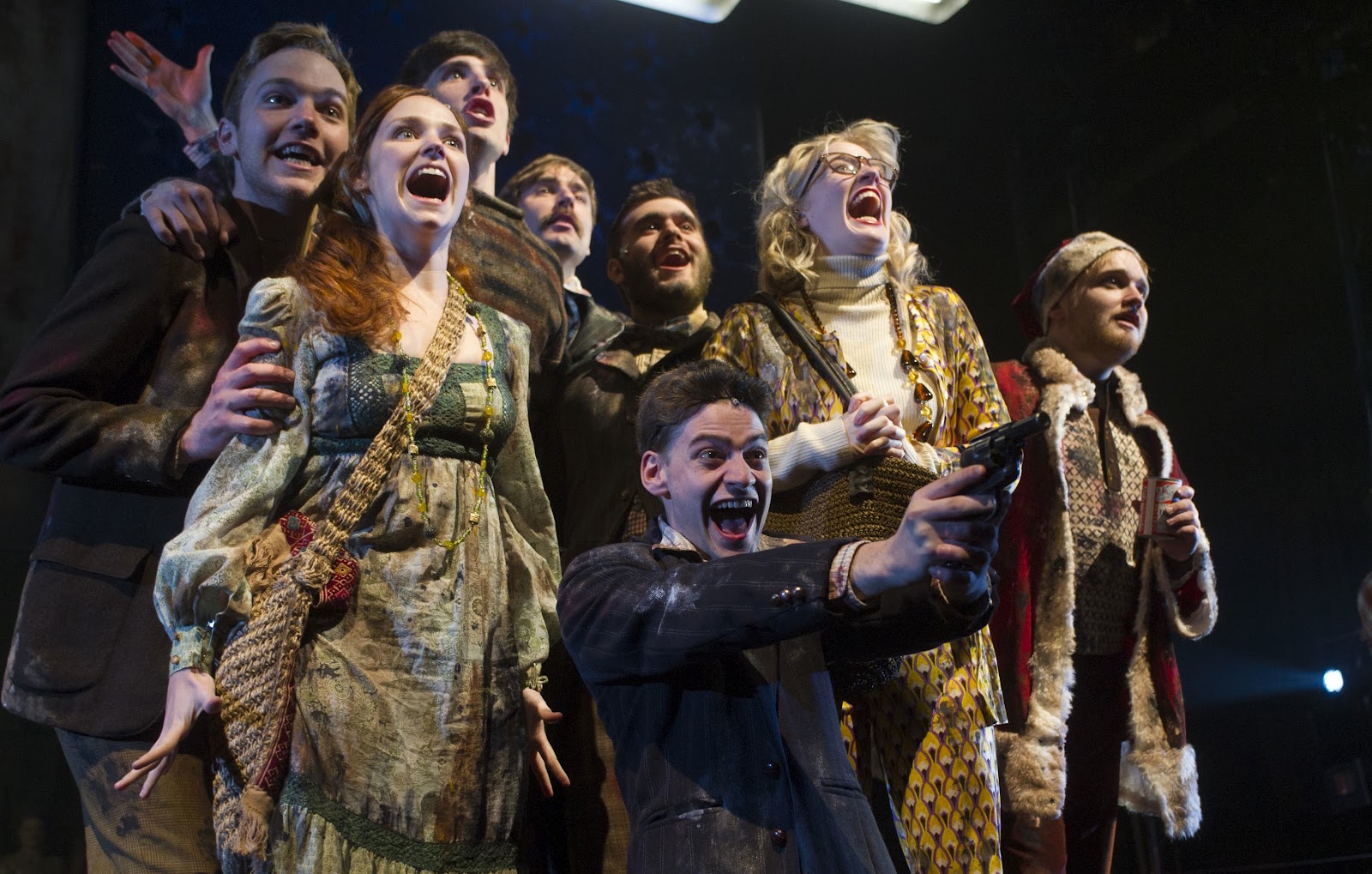
The crazy kids of Assassins
Ah, the "interesting failure."  Every major theatrical artist has one, even Shakespeare - and Stephen Sondheim has a couple - among which Assassins, from 1990, has always been particularly prominent.  I think there's just something so outré about the concept of this revue (I guess it's a revue) that it has exerted a kind of siren call over the musical theatre even though - well, by now we know it really doesn't work.  I mean a musical about assassins?? That's got to be interesting, right?  Well, it failed interestingly at its premiere, and then it failed a little less interestingly in a New York revival, too.  It likewise failed - perhaps even less interestingly - in several regional productions.  And now it has failed again, exuding only a mild level of interest, in a production by the BU School of Theatre, under the direction of Jim Petosa, which closed last weekend.  (I know, another post-mortem - but I'm almost caught up.)

Not that Petosa didn't work hard - he discarded the original "Step right up and shoot the President!" staging, opting instead for a hopeless, breadline-in-the-Great-Recession mise en en scène that relied on a bullet-riddled American flag out of Jasper Johns (or maybe Nashville), and hinted that the show's assassins were being drawn right up out of the audience (i.e., the Masses).  These were good ideas, but they didn't, finally, do much good; I think at this point we can safely say that Assassins is, indeed, a failure, and it's pretty obvious why: its concept may be "interesting," but it only works as an excuse for Stephen Sondheim to stretch out in a number of savage parodies (Marvin Hamlisch is neatly skewered in "Everybody's Got the Right," for instance).  But this invitation to misanthropic indulgence only yields maybe two numbers that can stand up to the rest of the Sondheim canon, and in the meantime, dramatically - whoo-boy, is Assassins ever a mess.

There are so many things wrong with it, in fact, that it's hard for a critic to decide where to begin; which mistake is the central one?  The show is like a sprawling network of dramaturgical error.  But what leaps out at you from the history books, of course, is that America's assassins simply share no connecting thread; they don't have a communal "history," much less a "concept;" so when they speak to each other across the historical ether, as they constantly do in Assassins, there isn't really that much for them to talk about.  John Wilkes Booth, for instance, was a successful, famous actor who led a racist conspiracy.  But Squeaky Fromme was a pathetic lowlife who managed to consistently skirt a laundry list of crimes of really appalling sadism and squalor.  Other killers were loners deranged by obvious mental, or even physical, demons, and a few could be loosely grouped as avatars of the downtrodden immigrants of the late nineteenth century.  And of course Lee Harvey Oswald was a self-destructive cipher who may - or may not - have been the patsy of a kind of coup, but who certainly never communed with Booth on any assassins' astral plane, as posited here.

Although frankly, if librettist John Weidman's concept is a mess, then Petosa's is also a little murky.  We get the vague idea that the whole production is intended to help us "understand" the potential assassins now obviously lurking in the Tea Party.  But sorry, I'm still unsympathetic;  I'm just not the type to confuse patronization with fellow feeling. And frankly, I don't even think the nutty Tea Partiers are desperately seeking celebrity; theirs is simply an evil mix of racism and ignorance, with little of the need for personal validation which is the closest Sondheim & Co. ever come to a psychological explanation for their singing shooting gallery.

This is all too bad, really, because the kids at BU did give these killers their, um, best shot, and a few scenes, particularly those between the gonzo Melissa Carter and Casey Tucker (as Sara Jane Moore and Squeaky Fromme) kind of worked.  Elsewhere the singing is stronger than the acting, but things never really bog down, they just never come together, either.  Evan Gambardella does throw off a weird kind of pseudo-innocent energy as both the "Balladeer" and Lee Harvey Oswald, and John Zdrojeski, as John Hinckley, hints at dramatic potential the role doesn't allow him to access.  The rest of the cast is more scattershot, although everyone hits the bulls-eye here and there.  Still, is that enough to float another production of Assassins?  I talked briefly with director Jim Petosa about this after the show, and he argued that academic resources are better spent re-evaluating intriguingly troubled shows than in simply mounting sparkling new productions of the tried-and-true.  Well - maybe.  You might answer that with the observation that until a student triumphs in a true classic, he or she has no yardstick of actual success. Of course there's surely room for both options in any curriculum, I think - but in the meantime, can we please put a bullet in Assassins for good?

Lost on the Camino Real with Beau Jest.
But alas, the BU Theatre Department hasn't been the only local troupe sipping the "interesting failure" Kool-Aid of late. Across town, at the indomitable Charlestown Working Theater, the widely-respected Beau Jest is currently (no, this is not a post-mortem, it runs through next weekend) attempting to revive Ten Blocks on the Camino Real, the one-act source of perhaps Tennessee Williams' most legendary Broadway bomb, Camino Real.

Beau Jest had a hit last year with another Williams one-act, the much-later Remarkable Rooming House of Madame LeMonde; but this time around, I'm afraid they only manage to confirm that Ten Blocks is an artistic traffic jam of truly epic proportions. And I mean truly EPIC proportions; this thing makes Assassins look coherent.

The scuttlebutt on the full-length version's Broadway failure has always been that director Elia Kazan forced Williams' fantasia into a naturalistic straitjacket. Having now sat through the (abbreviated) first version, I can only say I kind of admire Kazan for at least trying to wrestle this embarrassment into some kind of shape (Beau Jest just lets the pieces fall where they may). It's essentially a pretentious pastiche in which Williams' usual hobbyhorses - the stud vs. the seductress, the wisdom of the fallen queen, and of course "life" vs. "death"- all meet in a kind of car crash on some cosmic Latin highway. There are a few poetic stretches, to be sure, along with a tone of amusingly deadpan political horror. There's atmospheric Day-of-the-Dead accompaniment from a live trio that sometimes helps paste things together.  But I'm afraid even when something works, it doesn't work for very long.

The Beau Jest version, directed by Davis Robinson, is nevertheless funkily likable, even though it doesn't come close to getting the dramatic job done. The basic problem is that these folks are essentially very smart comedians - so they nail the droll asides that Williams often wickedly slips into, but can't really convey at all the "wild and moving" sense of dramatic freedom the playwright thought he was unleashing. Gypsies re-growing their maidenheads as they dance wildly in the moonlight, death as a form of orgasm - sorry, much as I love 'em, this just ain't Beau Jest; imagine the Flight of the Conchords trying to do Blood Wedding and you've got roughly the situation here. As expected, the comic scenes - particularly an amusing shakedown by the local fortune teller - worked best; the orgasmic flights toward inevitable Death, less so. And then there were the ridiculous interpolations from Cervantes, Proust, and others (Don Quixote AND the Baron de Charlus both wander through!); Beau Jest offered a weak smile here at the playwright's own pretensions (Williams is hardly on a par with either writer), but couldn't make much more of these interludes.

Oh, well. I suppose I'm glad that I've seen this rarity, but I can't honestly say I'd willingly sit through it again. And perhaps it's time we began to formulate a critical approach - or even a mode of intervention - toward the temptations of the "interesting failure." A first precept might be to resist the illusion that audiences of the past were necessarily philistines (and at any rate, let's face it, even philistines sometimes have a point). The second might be to question the true "interest"of a failure that only rehashes, or just plain hashes, elements which reach obvious fruition - or at least balance - in an artist's other, successful works (as is the case with Ten Blocks). I mean, is it so "interesting" to discover that a particular gambit works in one way, but not another? Perhaps to an academic  - but rarely to an audience.

Friday, June 10, 2011

Golden Section

The strange finale of Caesarean Section.
American theatre doesn't really do "raw" anymore.  In fact I can't think of a professional show I've seen in the last oh, five years or so that dared to flaunt its vulnerability, much less its rough, warts-and-all humanity.  Or one that risked looking long and hard at the dark places within us without the props of adolescent bravado or alienated chic (or, in fact, cultural or literal amplification of any kind).

But somehow the Poles have clung to that defiant ideal, long after the American theatre has forgotten all about Grotowski, artistic community, and (eeek!) poverty.  Which made the brief appearance by Teatr Zar at the Charlestown Working Theater last week bizarrely refreshing, even though the performance was entirely absorbed in the question of suicide.

No, this was not The Drowsy Chaperone.  (It was a far more fascinating show than that was!)  And it wasn't exactly depressing, either - in part because it wasn't simply about suicide, not exactly; it was instead about pulling back from suicide, about going up to the edge but not over, about that Beckettian decision to soldier on despite everything.  (Not for nothing did the title of the piece refer to a difficult birth against the odds.)

Of course that's still enough to scare off the SpeakEasy crowd, but I was surprised to find the Zarists (sorry) playing to a full, appreciative house in Charlestown - despite the threats of oncoming tornadoes and power outages.  Those adventurous souls got to ponder a form of theatre unlike that being seen on any other stage in this city right now: Teatr Zar is poised somewhere between dance, musical performance, and religious ritual.  There's no text per se, just movement and song - although there's plenty of drama, and a disturbing level of physical risk: the "show" opened with the Zarists smashing up glass in the dark, and they carried on their performance barefoot despite the presence of a thin river of glittering pain bisecting their tight little stage (above left).

Said performance was seemingly designed to directly translate the emotional and spiritual into the physical, in a manner which elided clear explication.  (Indeed, the "poetic" text provided in the program I think was something of a mistake.)  Two women (Ditte Berkeley and Emma Bonnici) and one man (Martej Matejka) were generally center stage, struggling against each other with a force utterly unlike the practiced mime of stage combat.  All were clearly trained in movement, yet somehow their actions felt unskilled, awkward (they often fell to the floor with a wince-worthy crash).  Grace was what they sought (they sometimes climbed atop each other to get closer to heaven), yet that was precisely what always eluded them; clearly they didn't know how to live, neither with each other nor with themselves.  I couldn't say that the piece built to a "conclusion" - it felt more like a single moment repeated in several variations - but it certainly conveyed the throes of emotional desperation with intense clarity.

This was largely due to the piece's musical dimension: its archetypal "characters" suffered (almost always) in silence, yet a startling score gave them voice - in a set of wailing, polyphonic "songs" drawn from Corsican musical traditions, played by a tight instrumental ensemble and led with frightening abandon by vocalist/cellist Nini Julia Bang.  The piece is worthwhile in musical terms alone, frankly - although the music is exquisitely integrated with the physical performance; there seems to be no separation between "musician" and "actor" here. 

The Charlestown Working Theater has been lucky of late in its visiting artists (I believe this weekend they're hosting yet another foreign visitor, Yaroslava Pulinovich's The Natasha Plays), and as a result, buzz has been building around this gritty, daring little space. So let's hope the CWT can expand its offerings as they rise in popularity (local donors, take note). Caesarean Section is actually only one part of a triptych of work from Teatr Zar; it would be wonderful if Boston audiences someday might be able to see this compelling piece in its entirety.

Sunday, May 15, 2011


Various trips and an outage at Blogger have prevented me from posting anything about The Seventh Sense, an intriguing theatre piece by an Armenian troupe, the National Centre for Aesthetics SMALL THEATRE, that crossed the water to play our own Charlestown Working Theater a few weeks ago.

Which may have been just as well, because I wasn't entirely sure what to make of this particular show, at least in formal terms.  Its content was clear enough - if somewhat shocking.  I'm not kidding; conceived as a "sensual meditation" on The Book of Lamentations, a book of heartfelt prayer by Armenian patron saint Gregory of Narek, the piece was that rarity in our secular age: a work grounded in straightforward, even naïve, religious feeling.  Stranger still, it was staged with every trick in the postmodern handbook, sophisticated video and projections to the fore; indeed, the production often played like a Mabou Mines version of the Book of Revelation.  Minus any of the irony or alienation, however, that are thought to be the sine qua non of those downtown-drama techniques.

Instead, The Seventh Sense was suffused with a mood lost from the modern lexicon: guilt.  And not specific guilt, but generalized, original-sin guilt - the kind downtown artists don't have; indeed, the piece was unapologetically stylized as a Pilgrim's-Progress-style quest for salvation.  Thus hellfire literally filled the stage (at left), and a video clip peered closely at the skulls in a cathedral's crypt.  In case we somehow missed the point, Death himself soon rose from a billowing maelstrom on the darkened stage floor.  You're guilty, and you're going to die - when was the last time any of our local theatres pondered that question?

I'm afraid the answers supplied by The Seventh Sense were hardly original, however, and the piece was sometimes suffused with a kind of sexual hysteria regarding the flesh while simultaneously trading in sensual tableaux to make its "spiritual" points. Occasionally Seventh even played like some breathless cable documentary about the predictions of Nostradamus. But frankly, it was still refreshing just to feel the icy wind of judgment blowing from the direction of the stage.  And while visual artist Vahan Badalyan's design concept leaned too heavily on borrowings from art history (some of them ham-handed, as in the pseudo-Pietà at top), every now and then the production seemed highly self-aware, as when performer Arsen Khachatryan attempted to literally climb into da Vinci's The Last Supper. Other gambits, like the struggling "souls" projected onto the performers, were striking and evocative, and even the looming figure of Death was surprisingly spooky and visceral. The Charlestown Working Theater is gaining a reputation as the fringe theater that somehow crams poetic wonders into its gritty space; next up for this intrepidly globe-trotting little company is a visit from Poland's Grotowski-inspired Teatr ZAR, with a performance based on a "centuries-old polyphonic funeral songs." Fans of grim religious feeling should take note.

Friday, September 17, 2010

Stringing up the puppetmaster

Sometimes you really want to like a performer, despite his or her failings.

But sometimes, try as you might, you just can't.

I pondered this problem while watching Blair Thomas's new show, Hard Headed Heart, at the Charlestown Working Theater last weekend (which once again is offering a gutsy season, btw).  I wanted to like this show like hell.  Thomas is brilliantly versatile - in his "puppet shows" (somehow the phrase doesn't do these conceptual gambits justice) he plays most all the roles, and provides the narration, musical accompaniment, and sound effects too - along with just about everything else.  When he's not banging on a drum kit, or puffing on a tuba, he's expertly manipulating an array of evocatively-designed marionettes, and doing all their voices.  I've rarely seen a performer work harder.

And the "shows" themselves are marvels of ingenious design.  Each of the three pieces in Hard Headed Heart came with its own theatre - drama machines on wheels, if you will, equipped with in-house orchestras, stereo and projection systems, and all manner of props, tricks, and trap doors.  These pint-sized productions - and the contraptions that embody them - are almost relentlessly imaginative, and redolent with ghastly, Grand Guignol atmosphere.

But unfortunately the maestro himself, Mr. Blair Thomas, isn't a particularly warm or engaging presence - indeed, he plays puppetmaster with the kind of cold-blooded condescension that always kills things at the A.R.T.  (You can almost hear his type cackling, "Pathetic earthlings . . . don't you know Death is always pulling the strings???")  But alas, I'm afraid warmth - or at least humanity - is what's required to put over the crude rough-and-tumble of the first piece on the program, Lorca's "The Puppet Play of Don Cristóbal," (at top), with its long stretches of violence and its hearty embrace of lust; without it, the Punch-and-Judy cruelty just gets tedious.

A similarly snide distance undermined "St. James Infirmary," a meditation on the folk and jazz standard about the heartbroken drunk who has just seen his girl "stretched out on a cold white table" at the eponymous infirmary.  She was "so sweet, so cool, so fair,"  he moans, but the song is not only an elegy but also a defiant cry against death, with the singer's demand that at his own funeral, "a twenty-piece jazz band . . . raise Hell as we go along." Thomas's macabre version (at left), however, hid no such poignant, life-affirming punch; indeed, it merely got creepier as it went along, with the girl's skeleton taunting the grieving singer with her red, fuck-me high heels.  "I'm so blue my favorite hooker's dead," seemed to be the only message of this version.

Thomas's final number, based on Wallace Stevens's epochal "Thirteen Ways of Looking at a Blackbird" was likewise reductive - it seemed to want to shoe-horn this open-ended classic into the doomed-romance template of the rest of the evening.  Still, its melancholy accompaniment - Ben Johnston's String Quartet #4, which seems to slowly encrypt the hook from "Amazing Grace" - was gently appropriate.  And the piece's imagery - four back-lit scrolls on which panoramas were slowly, softly assembled - engendered something of the poem's quiet sense of meditation and ontological disruption.  Best of all, Thomas didn't actually "perform," and hence there was no metaphorical snickering to mar the piece's truly evocative moments.  More, please - and less.

Friday, March 6, 2009

Short cuts

A few quick notes on smaller productions seen recently:

Last weekend the Charlestown Working Theater closed a kind of story-theatre version of The Odyssey, developed and performed by husband-and-wife team Jennifer Johnson and John Peitso (Johnson runs the theater). The piece, which also included poetry from Louise Gluck, T.S. Eliot, and Claribel Alegria, proved striking in many of its haunting effects. Johnson and Peitso had set themselves adrift in an actual rowboat in the middle of the theatre - with a silvery moon slung low in the "sky" behind them - and had devised potent, low-tech story-theatre gambits to evoke the many wonders of their tale: the Cyclops was sketched in brilliantly with just a flashlight, for instance, while shadow-puppetry subtly conjured the magic of Circe. And Peitso's musical interludes, on the dulcimer, harmonica, and other instruments, leant the proceedings just the right lonely-night-under-the-stars atmosphere. But oddly, while the piece seemed to want to focus on the longing felt between Odysseus and Penelope, the acting couple didn't actually share much stage chemistry, and had decided to delete several key scenes from their source (including most of its climax) while lingering on the interlarded work of the other poets, which didn't always re-inforce the clarity of their throughline. The piece therefore seemed somehow less than the sum of its poetic parts.

Meanwhile, over at the BCA, Centastage's world premiere of The Random Caruso, a satire of the Hollywood scene by local writer Andrew Clarke, will wrap up this coming weekend. I caught the piece at its actors' benefit on Monday, and was struck by its polish and confidence. Clarke knows how to structure his scenes, the details of his writing have the authority of lived experience, and his dialogue has real bite. Alas, the author simply doesn't have anything particularly new to say about the L.A. shark tank. We can tell he wants to avoid the familiar triangular-betrayal template of cultural touchstones like Mamet's Speed-the Plow, but he hasn't found another way to develop his material; instead, he essentially repeats himself in his second act. (Perhaps because in the end, dark comedies with only three lead roles perforce must lead to triangles and betrayals.)

Still, even the second time through, Clarke's scenes remained fun, thanks to three strong central performances, and Joe Antoun's sleek direction. I was least taken with Michael F. Walker as the tormented personal assistant and would-be screenwriter, even though I usually find Walker the best thing over at Actors' Shakespeare Project - this seemed all the stranger because I didn't think Walker got in touch with the character's guilty inner sliminess (usually this actor's specialty!). As his monstrous boss, Robert Pemberton may have gone up occasionally on lines, but sketched in the requisite nastily insecure, infantile egotism with offhand skill. The real find of the show, however, was Tracy Oliverio, who made quite the sexy-tough aspiring waitress. We hope to see Ms. Oliverio again soon, and often.

Wednesday, March 5, 2008

Where the toys are

This is just a quick note about the charming evening of 'toy theatre' presented by Great Small Works at the Charlestown Working Theater last weekend. Led by local puppetmaster John Bell, the performance proved evocative and provocative by turns, even if it had little to do with the toy theatres of the nineteenth century, as Bell claimed in an opening song that was perhaps too academically-tongue-in-cheek for my taste. No, Great Small Works is hardly into the frissons of gaslit mellerdrammer - think of them instead as a version of the venerable Bread and Puppet Theater writ small, very small, sprinkled with the same gently crunchy politics, and delivered with a side of literary introspection.

Indeed, the evening's first offering, "Blue Skies" seemed to cram the vasty fields of Vermont onto a tabletop, with room to spare; the piece deftly illustrated floods and tornadoes - along with the social perfidy that has led to the repeated inundations of New Orleans. As usual with Bread and Puppet, social horrors were presented piercingly and yet at a certain sad distance, and natural phenomena were sketched ingeniously. What is the strange, sweetly acute pleasure we derive from the miniature? Is it an intensification of our usual response to mimesis (look it up), or something else entirely?

These and other questions floated pleasantly through my head during the more melancholic second half of the program, "A Walk in the City," which was inspired by the work of Italo Calvino, and did capture something of his sweetly rueful voice. Alas, the eponymous urban ramble perhaps rambled on too long, but as compensation included such small wonders as passing satellites (see above), and even a flickering movie - the production of which, like so much in this poetic program, struck me as no small feat.